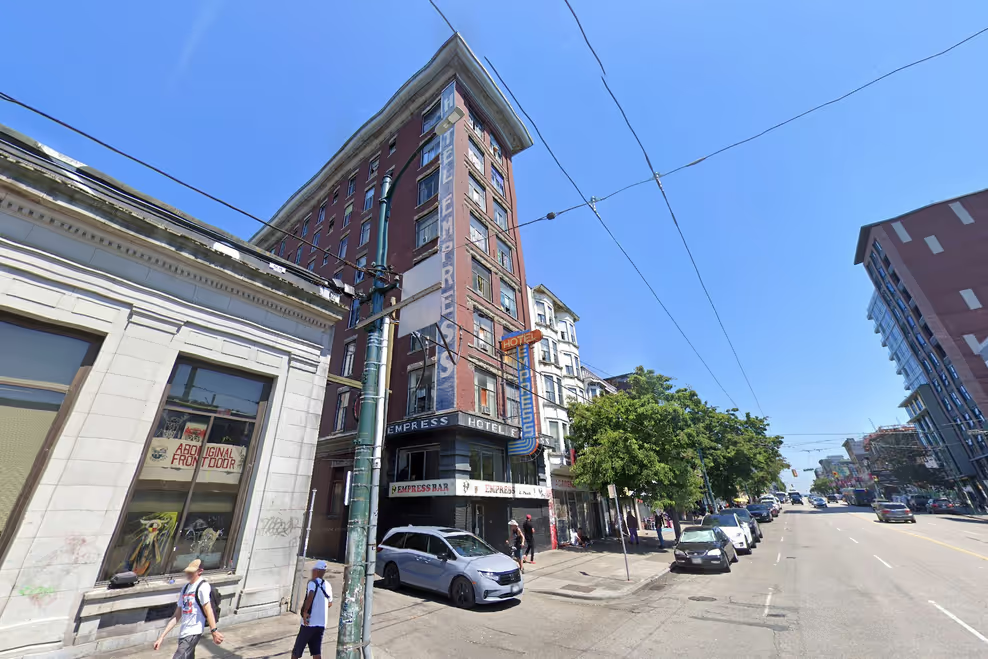
Downtown Eastside SROs Put 400 Tenants at Risk
Vancouver’s Downtown Eastside SROs are once again at the center of a housing crisis. Housing advocates now warn that roughly 400 low-income tenants could face displacement as a growing number of single-room occupancy buildings are sold, foreclosed upon, or placed into receivership.
The warning comes from the Downtown Eastside SRO Collaborative Society, a non-profit group that advocates for tenants living in privately owned SRO hotels. According to the society, the situation is worsening across a growing list of privately owned properties.
Why the Downtown Eastside SROs Crisis Is Escalating
The society is calling on all levels of government to create a permanent acquisition fund. This fund would let non-profit housing providers and community land trusts step in quickly whenever a financially troubled SRO property comes up for sale.
The most urgent case involves the 98-room West Hotel SRO at 488 Carrall St. A new landlord has reportedly been offering tenants money to leave the building. Some tenants received alternative housing, while others did not.
As a result, the society estimates that 57 rooms in the West Hotel are now vacant. Meanwhile, the same owner recently acquired two additional properties nearby.
These include the 44-room United Rooms SRO at 139 East Cordova St. and the 76-room Empress Hotel SRO at 235 East Hastings St. Consequently, the society fears both buildings could soon face similar efforts to clear out long-term tenants.
Notably, the West Hotel and Empress Hotel were already flagged over a year ago. At that time, advocates warned they could trigger a much wider SRO housing insecurity crisis across the neighborhood.
City Records Show Warning Signs Began Earlier
An internal City of Vancouver memo from June 2025 shows concerns started well before the recent ownership changes. Lenders had already begun foreclosure proceedings against both the West Hotel and the Empress Hotel.
At the time, the buildings were owned by Christopher Wall and described by city staff as heavily indebted. Lenders were seeking permission to sell the properties faster than the standard foreclosure timeline allows.
Importantly, the foreclosure petition listed vacant possession as a possible remedy. City staff stressed that no court had ordered this outcome, and it might never happen if the properties sold with tenants remaining in place.
However, staff also warned that if vacant possession were granted, protections under the B.C. Residential Tenancy Act would be limited. At the time, around 200 tenants were living across the two hotels combined.
In June 2025, the society told provincial and municipal officials that Wall had defaulted on $4.6 million in debt. Furthermore, it warned the foreclosures could destabilize his wider portfolio of seven Downtown Eastside SRO buildings.
City staff also noted that the municipal government could not intervene directly in the court proceedings. Since the city was not a party to the foreclosure, it held no registered legal interest in the properties.
In addition, simply emptying rooms would not automatically trigger the city’s SRO conversion rules. Because a vacancy alone is not considered a conversion or demolition, the $300,000-per-room replacement fee would not apply.
More Properties Now Facing Foreclosure Risk
According to the society, several other buildings are already in foreclosure or could soon follow. These include the 54-room Laurel Apartments SRO, the 36-room York Hotel SRO, and the 31-room Arlington Hotel SRO.
Other at-risk properties include the 85-room Silver Avalon Hotel SRO, the 27-room Persepolise Hotel SRO, and the 32-room Grand Union Hotel SRO. Beyond these, many additional SRO buildings have also been listed for sale recently.
The society warns that some landlords could empty buildings, complete minor renovations, and then re-rent rooms at much higher vacancy-controlled rates. As the society put it:
“If we don’t get action from governments to buy hotels, many more tenants will likely face aggressive campaigns to empty, lightly renovate and retenant their buildings with students or workers at the vacancy controlled rents.”
This pattern, if repeated across multiple buildings, would place even greater pressure on Vancouver’s homelessness crisis. After all, SROs remain housing of last resort for many of the city’s poorest and most vulnerable residents.
What Government Officials Are Saying
The society is now seeking immediate intervention to stabilize buildings already in foreclosure or receivership. Alongside this, it continues pushing for a permanent SRO acquisition fund to help non-profits act quickly.
In response, the B.C. Ministry of Housing and Municipal Affairs acknowledged awareness of the ownership changes. The Ministry told Daily Hive Urbanized that the province is “actively monitoring the situation.”
The Ministry stated its goal is to keep tenants in their homes. However, it did not confirm whether the province is considering purchasing any of the affected properties directly.
It also noted that SRO rooms fall short of long-term housing standards. Even so, officials acknowledged the units cannot be phased out until enough new replacement housing becomes available.
Additionally, the provincial government says it is working with the city to identify redevelopment and renovation opportunities. It is likewise pursuing available funding programs, including federal government funding sources.
The Broader Picture Across Vancouver
As of early 2023, Vancouver had 146 active SRO buildings containing roughly 6,500 units combined. Most of these sit within or near the Downtown Eastside neighborhood.
At that time, private owners held 48 percent of SROs, while governments or non-profits owned 50 percent. Chinese Benevolent Societies owned the remaining two percent of buildings.
Many of these structures were built a century ago and now sit in extremely poor condition. This stems from a mix of age, maintenance practices, and the complex needs of residents living inside.
Since 2025, the city has maintained a policy against any net increase in supportive housing capacity in the Downtown Eastside. Officials cite the area’s already dense concentration of social services and housing.
Instead, the city is focusing on one-for-one replacement of aging SRO buildings with new purpose-built housing. This approach aims to modernize the housing stock without further concentrating services in one neighborhood.
Finally, seasonal spikes in visible homelessness are also linked to poor living conditions inside many SROs. Because most buildings lack air conditioning, warmer weather often pushes more residents outdoors.