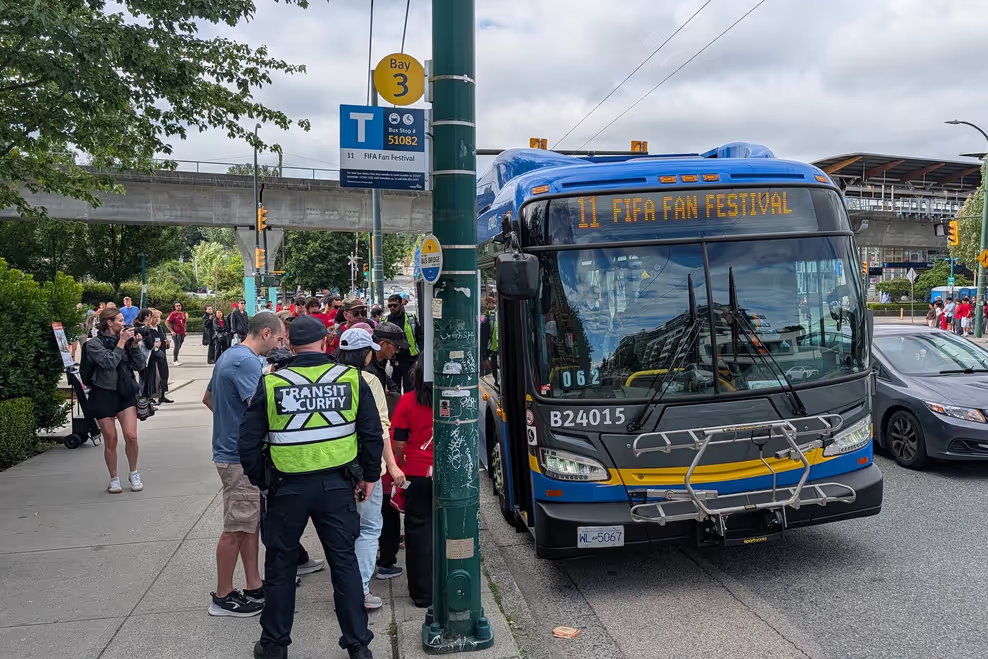
FIFA Fan Festival Express Bus Carries 130,000 Riders in Vancouver
The FIFA Fan Festival Express bus route became one of the standout transit success stories of Vancouver’s World Cup run. TransLink’s temporary No. 11 service carried roughly 130,000 passengers over the 28 days it operated. It ran on every day the fan festival was open during the 39-day FIFA World Cup period.
This high-frequency route linked two SkyTrain stations directly to the fan festival at the PNE fairgrounds in Hastings Park. Riders paid a standard fare to use it, since it was never offered as a free service. As a result, it functioned like a premium shuttle rather than a typical city bus route.
How the FIFA Fan Festival Express Route Worked
The No. 11 connected the Expo Line’s 29th Avenue Station with the PNE gate beside the Pacific Coliseum. Along its six-kilometre path, it made only one stop, at the Millennium Line’s Renfrew Station. Because it skipped every other local bus stop, the journey took just about 15 minutes end to end.
TransLink relied mainly on 60-foot articulated buses to keep up with demand. These buses ran every five minutes, starting two hours before the fan festival gates opened and continuing two hours after closing. However, Daily Hive Urbanized observed buses arriving even more often, sometimes as frequently as every minute.
A TransLink spokesperson confirmed that nine buses operated simultaneously to keep the FIFA Fan Festival Express moving. To free up enough articulated buses, TransLink temporarily reduced service on two SFU-area routes, including the No. 145 SFU Exchange/Production Way-University line. This trade-off gave the World Cup route the capacity it needed.
In terms of raw numbers, the No. 11 offered about 1,260 passengers per hour per direction. That’s notably lower than Metro Vancouver’s busiest bus route, the 99 B-Line, which handles around 1,800 passengers per hour per direction. Even so, the temporary route still managed impressive daily totals throughout the tournament.
Ridership Peaks Matched Big Match Days
Ridership on the express route closely tracked the excitement of the tournament. The busiest single day came on Wednesday, June 24, with 8,600 boardings recorded. That day featured Canada’s final group stage match against Switzerland, plus high-interest matchups between Brazil and Scotland, and Czech Republic and Mexico.
Saturday, June 27 came next, with 8,000 boardings during screenings of England vs. Panama, Colombia vs. Portugal, and Argentina vs. Jordan. Meanwhile, Thursday, June 18 saw 7,900 boardings, coinciding with the fan festival’s highest overall attendance of 40,943 people, driven largely by Canada’s home match against Qatar.
Several other dates also stood out. The route logged 7,700 boardings on Saturday, July 4, and 6,900 boardings on both Saturday, June 13, and Friday, July 19. Sunday, June 28 added another 6,600 boardings, showing consistent demand throughout the group stage and beyond.
Not every day drew huge crowds, though. Sunday, July 12, and Friday, July 17 recorded just 800 and 1,000 boardings respectively. On those dates, no World Cup matches were being played anywhere, so the fan festival only opened briefly in the evening for ticketed concerts.
Similarly, Friday, July 10 produced the lowest match-day total, with 2,300 boardings during the sole screening of Belgium vs. Spain. Still, whenever any match was broadcast at the festival, ridership consistently reached into the thousands, underscoring how tightly transit demand followed the tournament schedule.
Comparing the Route to Vancouver’s Regular Bus Network
Averaged across its full run, the No. 11 recorded about 4,600 boardings per day. Interestingly, that figure closely resembles the 2025 ridership pattern of the No. 23 English Bay/Main Street-Science World route. That regular route averages 4,700 weekday boardings, 4,000 on Saturdays, and 3,300 on Sundays and holidays.
For context, the No. 23 currently ranks as TransLink’s 47th busiest bus route among more than 200 routes across Metro Vancouver. Therefore, a temporary event-only service matching a well-established mid-tier route’s ridership is a genuinely strong result. It highlights how effectively TransLink planned the express link.
Attendance swings also shaped these numbers throughout the tournament. Festival hours varied considerably, running up to 12 hours during busy group-stage days but shrinking once the knockout rounds began with fewer daily matches. Favourable weather across most of the tournament further supported both festival turnout and bus ridership.
Final Takeaway
Overall, the FIFA Fan Festival Express demonstrated how targeted, high-frequency transit can support a major international event. By skipping local stops and running dedicated articulated buses, TransLink moved huge crowds quickly and reliably. The route’s performance offers a useful blueprint for future large-scale events in Metro Vancouver.