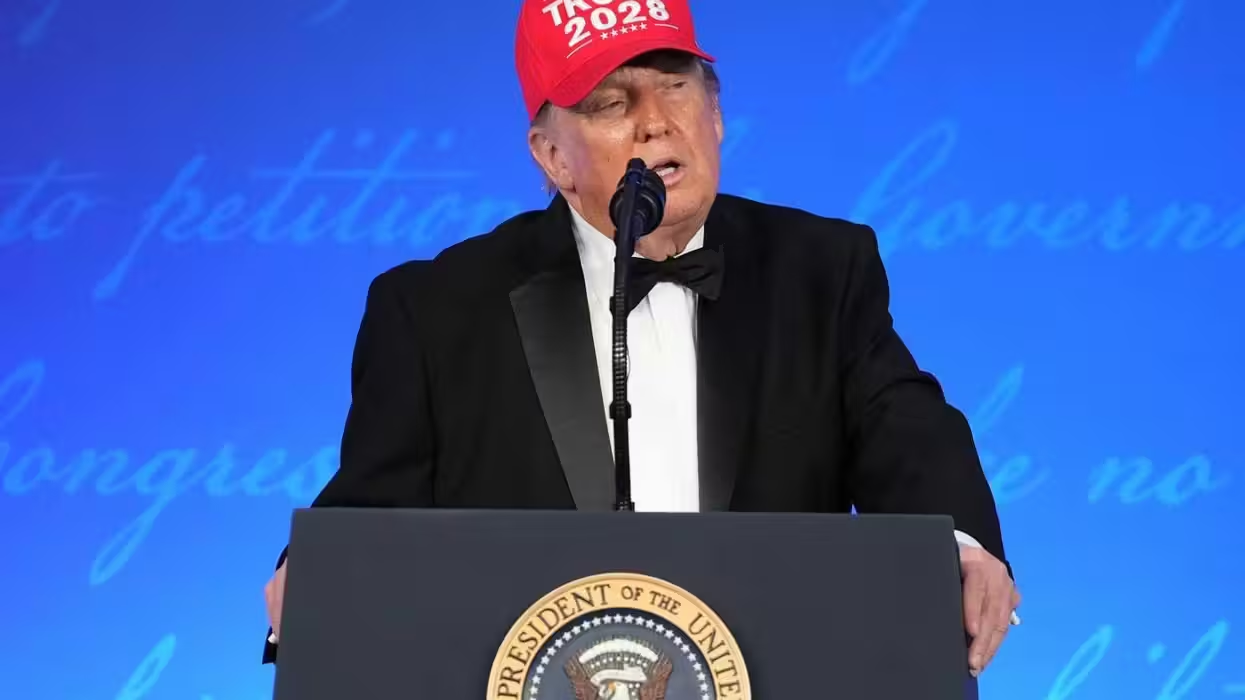
Trump Canada Bashing Is Reshaping Republican Views of Canada
Trump Canada bashing has become a regular feature of American politics in recent weeks. What was once an occasional jab has turned into a steady stream of insults aimed at America’s closest neighbor. As a result, rank-and-file Republicans are echoing the same hostile tone toward Canada.
President Donald Trump has long called Canada the “51st state.” He has also referred to Prime Minister Mark Carney as a “governor.” However, these remarks no longer surprise most political observers.
A Shift in Republican Rhetoric Toward Canada
According to Robert C. Rowland, a rhetoric professor at the University of Kansas, this pattern is unusual. He noted that “no other president has ever talked in the way that Trump does about Canada and our other closest allies.” Rowland also pointed out that Trump treats rivals like Russia and China with a similar tone.
Meanwhile, Trump’s poll numbers have slipped. Controversial domestic policies and an unpopular war with Iran appear to be driving that decline. Consequently, Rowland suggests the president is searching for someone to blame—and Canada often becomes that target.
This dynamic has trickled down to Congress. In fact, several Republican lawmakers have adopted similar language in recent public statements. Their comments suggest that Trump’s tone is no longer confined to the White House.
Wildfire Smoke Sparks a New Round of Insults
The anti-Canada rhetoric intensified earlier this month. Smoke from severe wildfires drifted south, blanketing parts of the United States. Soon afterward, Trump threatened tariffs in response to the smoke.
Republican lawmakers quickly followed his lead. One senator even promised legislation to sanction Canadian officials over the issue. Michigan state senator Aric Nesbitt posted a pointed warning on social media on July 16.
He wrote, “Unless you want to become the 51st state, learn to manage your forests.” That same day, Michigan Rep. John James issued what he called a “FINAL WARNING TO CANADA.”
James argued that “sovereignty comes with responsibility” when it comes to preventing wildfire smoke from crossing borders. These remarks reflect a broader shift in how some Republicans now discuss Canada publicly.
Notably, this tone marks a sharp break from history. Rowland recalled Prime Minister Brian Mulroney and President Ronald Reagan singing together at the 1985 Shamrock Summit. He also cited former president Jimmy Carter serving as an honorary pallbearer at Pierre Trudeau’s funeral.
“The closest country in the world to the United States, before Trump, was obviously Canada,” Rowland said. He added that mutual admiration defined the relationship from Teddy Roosevelt through Barack Obama. Even during trade talks in Trump’s first term, tensions never reached today’s level.
How Trump’s Words Are Changing GOP Opinion
Political scientists say Trump’s influence over his base explains much of this shift. Matthew Lebo, a professor at Western University, notes that Republican voters increasingly mirror Trump’s stated positions. For example, GOP views on tariffs, Iran, and NATO have all moved alongside his rhetoric.
Therefore, when Trump claims Canadians have treated the U.S. unfairly, many MAGA voters accept that framing. As a result, negative sentiment toward Canada has grown within this group specifically.
Gallup polling released in March illustrates this trend clearly. Canada’s favorable rating among Republicans fell from 85 percent in 2025 to 62 percent this year—a 23-point drop. In contrast, 95 percent of Democrats still view Canada favorably.
Independents also shifted, though less dramatically. Eighty percent viewed Canada favorably, down nine points from the previous year. Still, this figure remains close to 2024 levels overall.
Meanwhile, Canadian sentiment toward the United States has also cooled. Pew Research Center polling from June found only 33 percent of Canadians viewed the U.S. favorably. That number has dropped sharply from 54 percent in 2024.
Some Republicans see political opportunity in this messaging. Lebo suggests that bashing Canada may energize MAGA voters ahead of primary elections. These voters, he notes, are less likely to turn out when Trump isn’t on the ballot.
Additionally, criticizing Canada can help lawmakers demonstrate loyalty to Trump. In an administration where loyalty carries significant weight, this strategy makes political sense for some. However, Lebo warns this approach carries real risks.
He explained that a message appealing to the MAGA base may not work broadly. “It’s not always the same thing, what is smart electoral politics for me versus what is smart electoral politics for my party,” Lebo said. Ultimately, he noted, every politician wants re-election.
This growing polarization places Canada in a difficult position. Because U.S. politics can swing sharply between elections, Canadian officials face constant uncertainty. Consequently, a single election outcome could reshape the entire bilateral relationship once again.
In summary, Trump’s repeated attacks on Canada are reshaping how many Republicans view their northern neighbor. While most Americans still hold favorable opinions of Canada, that goodwill is eroding within Trump’s base. As polarization deepens, the long-standing U.S.-Canada friendship faces new and unfamiliar strain.