Ontario Tariff Threat Puts Small Cosmetics Firm on Edge Ahead of August Deadline
The latest Ontario tariff threat from Washington is rattling small businesses across Canada. A St. Catharines cosmetics company that sends a fifth of its products south of the border says the mood among entrepreneurs has shifted from caution to genuine alarm.
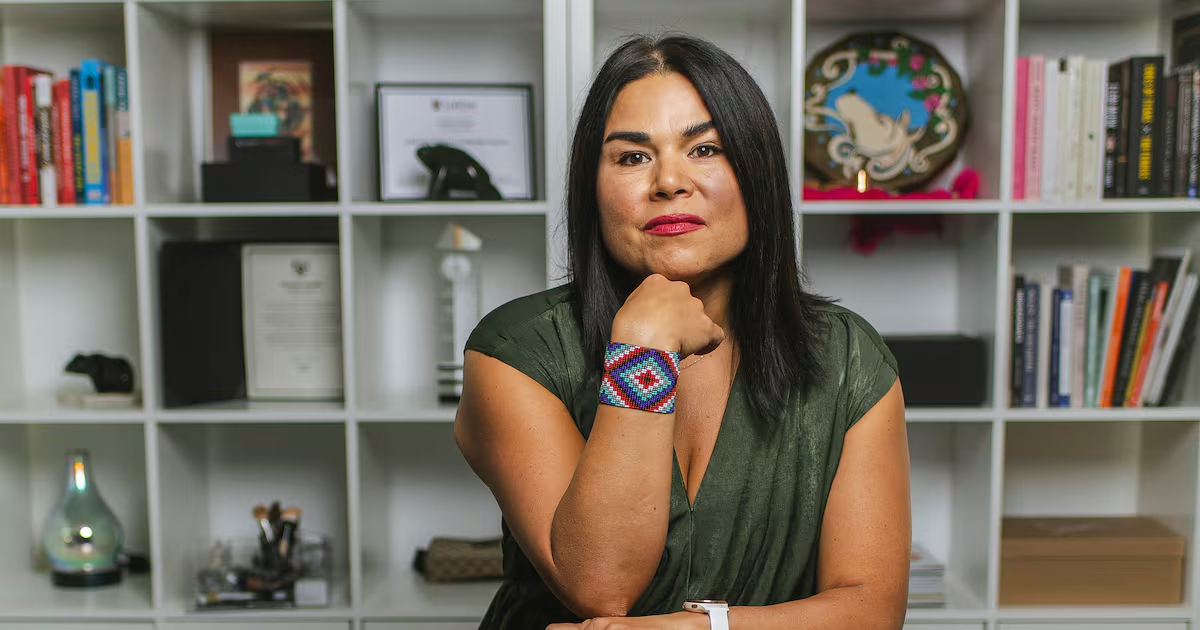
Jenn Harper, founder and CEO of Cheekbone Beauty, says this round feels different from previous trade disputes. Her company is one of the first Canadian Indigenous-owned and founded cosmetics brands, and it now faces a steep new cost of doing business in the United States.
Why the New Tariff Threat Feels Different
U.S. President Donald Trump announced this week that, starting Aug. 19, a 50 per cent tariff will apply to a wide range of Canadian goods. Notably, some of these products are currently protected under the countries’ free trade agreement.
Officials in Washington point to unfair trade practices as the reason behind the move. They specifically cite provincial bans on U.S. alcohol as one justification for the sweeping tariff plan.
“This number (50 per cent) is obviously far more concerning than what we heard in the past,” Harper told CP24.com in an interview this week.
Cheekbone Beauty supplies its products to Sephora in Canada and JCPenney in the United States. The American market currently makes up about 20 per cent of the company’s overall business, which employs four full-time staff.
Harper described the unpredictability of last year’s trade tensions as exhausting for small business owners like her. According to her, near-constant policy shifts made forward planning almost impossible.
“As we saw last year, there were so many moving parts during this time that it was truly hard for an operator to actually make a decision because things were just constantly moving and changing,” she said. “When you felt like you had your footing, of course, something else would happen.”
A Manufacturing Shift That Now Carries New Risk
In response to growing demand for Canadian-made products, Cheekbone Beauty moved part of its manufacturing from Italy to a domestic supplier last year. The decision aimed to please loyal Canadian shoppers who wanted homegrown goods.
However, that same shift now creates complications on the U.S. side. Harper explained that producing goods in Canada, while good for local customers, may hurt affordability for buyers across the border.
“Bringing them here to make them in Canada so that our Canadian consumer would be happy and now (we) understand that it will be not great for our U.S.-based customers because of this,” she said.
So far, Harper’s company has chosen to absorb tariff-related costs rather than pass them on to American customers. Still, she admits this strategy comes at a real cost to the business.
“Obviously that cuts into our margin… but we have customers that we’re trying to service all across North America and we didn’t want this to impact them,” she said.
Small Business Groups Warn of Serious Fallout
Dan Kelly, president and CEO of the Canadian Federation of Independent Business, says this tariff threat could prove fatal for some companies if it goes into effect. Meanwhile, small and medium-sized businesses face far fewer options than larger corporations when it comes to shifting trade partners.
“It’s fairly broad (and) would affect a whole bunch of businesses, in particular, a whole bunch of small and medium sized companies…. They have fewer options in terms of just shifting trade from one person or one place to the next,” Kelly told CP24.com.
According to Kelly, a 50 per cent tariff could wipe out companies that depend heavily on U.S. sales. Consequently, businesses without a strong domestic customer base may struggle to survive the change.
“For some businesses, you know a 50 per cent tariff on their goods on exports to the United States would essentially make their business defunct. They would not make sales to the U.S. and if that’s a critical market for you, it could be deeply, deeply troubling,” he said.
The list of affected goods is lengthy and varied, ranging from wine and hockey sticks to cement. Trump is using Section 338 of the Tariff Act of 1930, a Depression-era legal tool that has never previously been applied.
Even so, Kelly notes that not every tariff threat becomes reality. In fact, historical trends suggest most announcements never actually take effect.
“Over the last year-and-a-half, we’ve seen that only one in every 10 threats to tariff goods from Canada actually materializes so there are a lot more threats to tariffs than there actually are tariffs on Canadian goods or services at this moment,” Kelly noted.
“But we can’t discount that either. This is a significant one, 50 per cent, a very high level, and its application on a whole host of goods that are right now tariff-free,” he added.
Is There a Pathway Through the Trade Dispute?
The tariff threat arrives while Canada, the United States, and Mexico continue negotiating their trilateral trade agreement. Despite the tension, Kelly believes the announcement may actually hint at a possible resolution.
“The fact that they have highlighted three areas in the trading relationship: dairy, autos, and liquor, that is a narrower list than they’ve had in the past,” he said. “It does suggest that perhaps if there are some changes, we may be able to get a deal.”
Dairy remains a particularly sensitive topic for Canadian trade negotiators. Nevertheless, Kelly suggests there may be room for compromise without dismantling the country’s supply management system entirely.
“The complaint from the U.S. is less about supply management more broadly and more how much U.S. dairy producers are able to send into Canada compared to the EU,” Kelly said. “So maybe there is a pathway that would allow the country to negotiate a slightly higher allocation for U.S. producers while still protecting the guts of the supply managed agreement.”
Kelly says it remains unclear how much the ongoing “buy Canadian” movement will offset losses if the tariffs take effect. Some products on the list are consumer-facing, while others are more industrial, which makes predicting the impact difficult.
“There’s a variety of food products on this list, some manufactured goods, on this list. Some of them though are more industrial in nature. So how much of a buy Canadian philosophy is going to help out, it’s hard to see,” he said.
Canadian Shoppers Have Rallied Before
Harper remembers a similar wave of tariff talk last year that pushed many Canadians toward buying local. During that period, Cheekbone Beauty saw a noticeable, though short-lived, jump in domestic customers.
“We’ve been grateful because we have truly an incredibly loyal audience that I think loves our brand beyond our products,” she said.
Despite the uncertainty, Harper remains confident that Canadian entrepreneurs will adapt as they have in the past. Ultimately, she believes resilience will carry small businesses through this latest chapter of trade tension.
“The only thing that I know for 100 per cent certain is that Canadian entrepreneurs, we’re resilient and we’ve figured it out before and we’ll figure it out again,” she said.