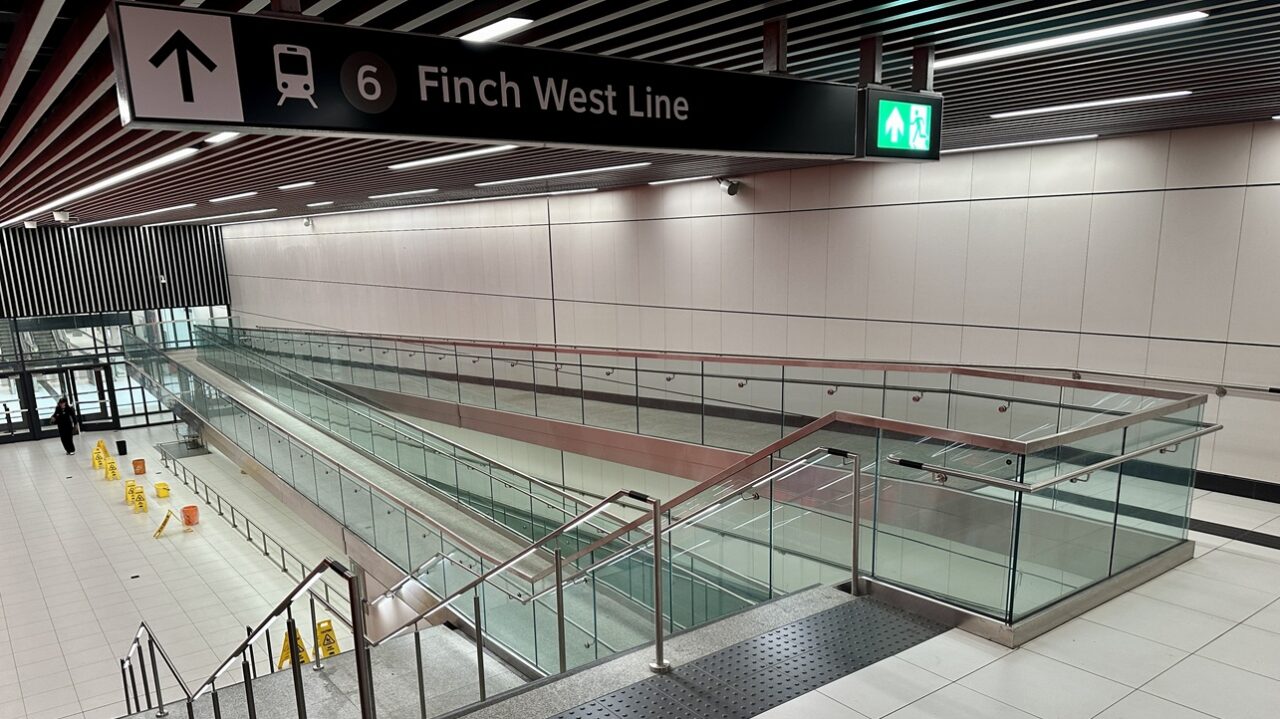
'Stupidest' Finch West Station Ramp Sparks Renewed Calls for Better Transit Accessibility
The Finch West station ramp has become a flashpoint for disability advocates in Toronto. Riders who use wheelchairs or scooters now face a long, winding climb instead of a direct elevator between Line 1 and Line 6. Advocates say the design choice shows how accessibility can still be an afterthought, even on brand-new transit infrastructure.
The Finch West LRT has been running for several months. However, accessibility advocates remain frustrated with Metrolinx over the massive ramp built to connect the two lines, especially since no elevator links them directly.
A Ramp Longer Than a Jumbo Jet
David Lepofsky, chair of the Accessibility for Ontarians with Disabilities Act Committee, did not hold back when describing the connection. “We call this the stupidest ramp in the world because it requires people with disabilities to push their wheelchair up a ramp that’s longer than a 747 jumbo jet,” he said.
Lepofsky, who is blind and also hosts the Disability Rights and Wrongs: The David Lepodcast podcast, recently visited the only direct indoor connection between the TTC Finch West subway station and the Line 6 Finch West station. In a video posted this week that has already drawn around 12,000 views, he walked viewers through the two options riders are given: a staircase with 23 steps, or a three-level ramp stretching roughly 260 feet.
According to Lepofsky, the ramp does not offer the turning radius that power wheelchairs and scooters actually need. As a result, many riders are forced into awkward, multi-point manoeuvres just to change direction. He also pointed out that using a ramp to move between floors inside a building is an unusual design choice in the first place.
“It’s not that they didn’t know you need an elevator because they have elevators to get from the Line 1 platform to the street, an elevator to get from the Line 6 platform to the street,” Lepofsky told CityNews. “It doesn’t take a rocket scientist to figure out they needed an elevator here. They chose not to do it, and they owe us people with disabilities and the public an explanation as to why.”
Advocates Say the Design Fails Wheelchair Users
To see the problem firsthand, CityNews met Darren Parberry at Finch West station. Parberry is an accessibility advocate who also runs the YouTube channel Transit History by Mobility Scooter. He attempted to navigate the ramp for the first time on camera.
“Are you serious? I don’t know whether I can do it or not,” Parberry said after seeing the ramp in person. As he made his way down, he had to stop at every landing and reverse at least once just to complete each turn. He also noted that small benches placed at the landings created additional obstructions for riders trying to manoeuvre through the space.
“Someone dropped the ball plain and simple,” Parberry said once he reached the bottom, calling the entire experience frustrating. “It’s beyond stupidity… It’s bordering on arrogance.”
Beyond the ramp itself, Parberry flagged several other design issues at the station. For instance, a large tiled area appeared to have been blocked off after flooding, creating a slip hazard for riders. He also said tactile guidance leading to the station’s multiple elevators simply was not installed.
Metrolinx and TTC Respond to Accessibility Concerns
CityNews reached out to Metrolinx, the provincial agency that oversaw the private-sector construction of the Finch West LRT, to request an interview. No one was made available. Still, officials shared a statement saying the agency is committed to building a system that is “safe, accessible, and inclusive for all customers.”
“Metrolinx consulted with the TTC and the TTC’s Advisory Committee on Accessible Transit on the design of the connection between Line 1 and Line 6,” the statement read. “We recognize the importance of ongoing feedback and continuous improvement, and we are undertaking testing with individuals with a wide range of disabilities to better understand customer experiences.” The agency added that it “continue[s] to work closely with the TTC to ensure customers continue to have safe, convenient, and accessible access at all of the Line 5 and 6 stations.”
Meanwhile, Lepofsky said he wrote directly to Metrolinx about the issue. As of Thursday afternoon, though, he had not received any response.
Islington Station Raises Similar Concerns
Because of ongoing worries about long ramps in new transit builds, advocates are now also watching the planned bus terminal and entrance at Islington subway station. Public renderings show a large, multi-ramp descent down to the existing subway concourse, and the project is currently set to open in 2027.
The TTC addressed the Islington design directly in a statement. “The west entrance ramp was designed with accessibility in mind. It is broken into shorter segments with level landings at the middle and at the ends of each segment, allowing customers to rest or stop as needed along the way,” a spokesperson said.
The statement also noted that “consistent with all Easier Access projects, the Islington station designs were presented for review to the design review subcommittee of the Advisory Committee on Accessible Transit,” and that the subcommittee’s feedback was incorporated “where feasible.” In addition, the TTC explained that a “direct street-to-platform elevator at the west entrance would require building over the existing station structure,” which conflicts with surrounding road and property development plans.
What Advocates Want Next
Both Parberry and Lepofsky argue that transit agencies need to treat accessibility as a core requirement, not a bonus feature. “There are lots of able-bodied people, and they figure, ‘Don’t worry, it’s just an inconvenience.’ No, it’s more than an inconvenience; It’s more of a major barrier,” Parberry said.
Lepofsky went further, calling directly on the provincial government to intervene. “We’re calling for this to be fixed,” he said, referring to the Ford government. “We’ve called on Metrolinx to commission an independent accessibility audit of the new Line 5 and the new Line 6. Let’s get an independent expert in to confirm where the barriers are and what needs to be done to fix it.”
For now, riders who use wheelchairs, scooters, or other mobility devices are left choosing between a steep staircase and a lengthy, winding ramp. Consequently, many advocates say the situation at Finch West station should serve as a lesson for every future transit project across Ontario.