Houthi Red Sea Blockade: Yemen Rebels Target Saudi Shipping
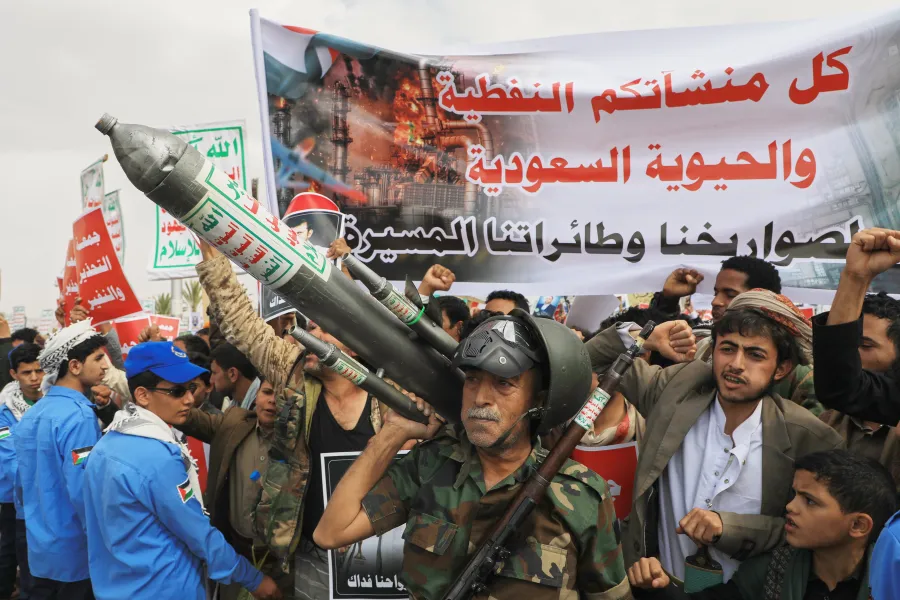
Yemen’s Iran-aligned Houthi movement has announced a new Houthi Red Sea blockade against Saudi Arabia. The rebels say the move is retaliation for a decade-long Saudi blockade on Yemen. It also follows a recent Saudi strike on Sanaa International Airport. The announcement raises fresh fears of a wider regional conflict.
Houthis Announce Immediate Blockade on Saudi Arabia
Houthi military spokesperson Yahya Saree confirmed the blockade in a video statement on Monday. He called it an “equation of ‘an eye for an eye.'” According to Saree, the ban on Saudi maritime traffic takes effect immediately.
Nasruddin Amer, deputy head of the Houthi media office, added further details on social media. He said the group would close the Bab al-Mandeb strait entirely. Amer described this step as a direct response to Saudi Arabia’s “unjust blockade on Yemenis for over 10 years.”
Saree also issued a stark warning to Riyadh. “We affirm the right of our great people to respond to the blockade with a blockade,” he said. He added that the Houthis are ready to meet any Saudi provocation with “a comprehensive and decisive escalation.”
The Houthi Red Sea blockade marks one of the most serious escalations between the two sides in years. Meanwhile, Saudi Arabia has not yet issued an official response to the announcement. Analysts are now watching closely for how Riyadh will react.
Why the Bab al-Mandeb Strait Matters for Global Trade
The Bab al-Mandeb strait sits at the southern tip of the Arabian Peninsula. It serves as the main gateway into the Red Sea. Roughly 12% of global trade normally passes through this narrow 32-kilometer waterway.
A quarter of the world’s container shipping also relies on this route. Vessels use it to reach the Suez Canal from the Indian Ocean. Therefore, any disruption here has consequences far beyond the region.
The Houthis previously proved they could disrupt this corridor. During the Israel-Hamas war, they targeted more than 100 vessels traveling through the area. However, it remains unclear whether they will repeat that scale of attack against Saudi targets now.
If shipping firms avoid the strait, they must reroute around the Cape of Good Hope. This detour significantly raises fuel costs and delivery times. Consequently, global supply chains could feel the impact of this Houthi Red Sea blockade within weeks.
Saudi Arabia is already under separate pressure over its energy exports. The kingdom has been using its East-West Pipeline to move crude oil to the Red Sea. This route serves as a workaround because the Strait of Hormuz remains restricted following Iranian action after February’s U.S.-Israel strikes.
Background: Escalating Tensions Since the Sanaa Airport Strikes
Yemen’s civil war began in 2014 when Houthi rebels seized Sanaa and forced the government into exile. Saudi Arabia then led a coalition against the group. It imposed an air and sea blockade on Yemen back in 2015.
A truce between the two sides was reached in 2022. However, recent events have placed that agreement under serious strain. The Houthis claim Saudi Arabia struck Sanaa airport in an attempt to intercept a flight carrying Houthi leaders.
That flight was reportedly returning from Iran after Houthi officials attended the funeral of Supreme Leader Ayatollah Ali Khamenei. Fortunately, the plane landed safely at an alternate airport. Still, the incident triggered a swift military response from the rebels.
In retaliation, the Houthis launched missiles and drones at Saudi Arabia’s Abha International Airport. Experts told the Associated Press this was among the most significant confrontations between the sides in years. By allowing the flight to land without coalition approval, the Houthis also signaled a broader ambition to control Yemen’s airspace independently.
The Houthis remain a key member of Iran’s so-called “Axis of Resistance.” This network also includes armed groups in Lebanon, Iraq, and the Palestinian territories. Nevertheless, sources close to the group say its drone stockpile has been shrinking.
Several Houthi members previously told the Associated Press that supplies ran low after months of attacks during the Gaza war. The ongoing Iran conflict has further slowed weapons deliveries to the group. As a result, the true scale of this new campaign remains uncertain.
The U.S. and Israel had earlier responded to Houthi shipping attacks with a sustained air campaign across rebel-held Yemen. That pressure eventually led to a deal in which the group halted its assaults on vessels. Whether a similar deal emerges this time will depend on how far this new Houthi Red Sea blockade escalates in the coming days.