Canada Wildfire Smoke: Senator Says Help Without Threats
As wildfire smoke drifts across the U.S. border, a growing political divide is forming over how America should respond to its northern neighbour.
U.S. Senator Adam Schiff has pushed back against President Donald Trump’s tariff threats tied to Canada wildfire smoke, arguing that American states should return past favours with support rather than hostility. His comments come as smoke from Canadian wildfires continues to blanket cities across the U.S. Midwest and Northeast.
The disagreement highlights a sharp contrast in tone between Washington lawmakers. While Trump has demanded accountability and financial penalties, Schiff is calling for solidarity instead. Their competing responses now sit at the center of a heated cross-border debate.
Schiff Pushes Back Against Trump’s Threats
Senator Schiff addressed the issue directly in a social media post shared on Sunday. He reminded Americans of Canada’s past assistance during California’s devastating wildfires.
“When California was burning, Canada sent fire fighters, planes and assistance — not insults,” Schiff wrote. His statement drew a clear line between diplomatic cooperation and political blame.
He continued by urging U.S. states to repay that support with compassion rather than confrontation. “As California and other states step up to repay the favour, we should do so without the threats and ramblings of a failing leader. We should show some humanity,” Schiff said.
His remarks were a direct response to Trump and several Republican lawmakers, who have called for holding Canada responsible for the smoke drifting into American skies. That smoke has already triggered air quality warnings across Michigan, Ohio, Illinois, New York, and Indiana.
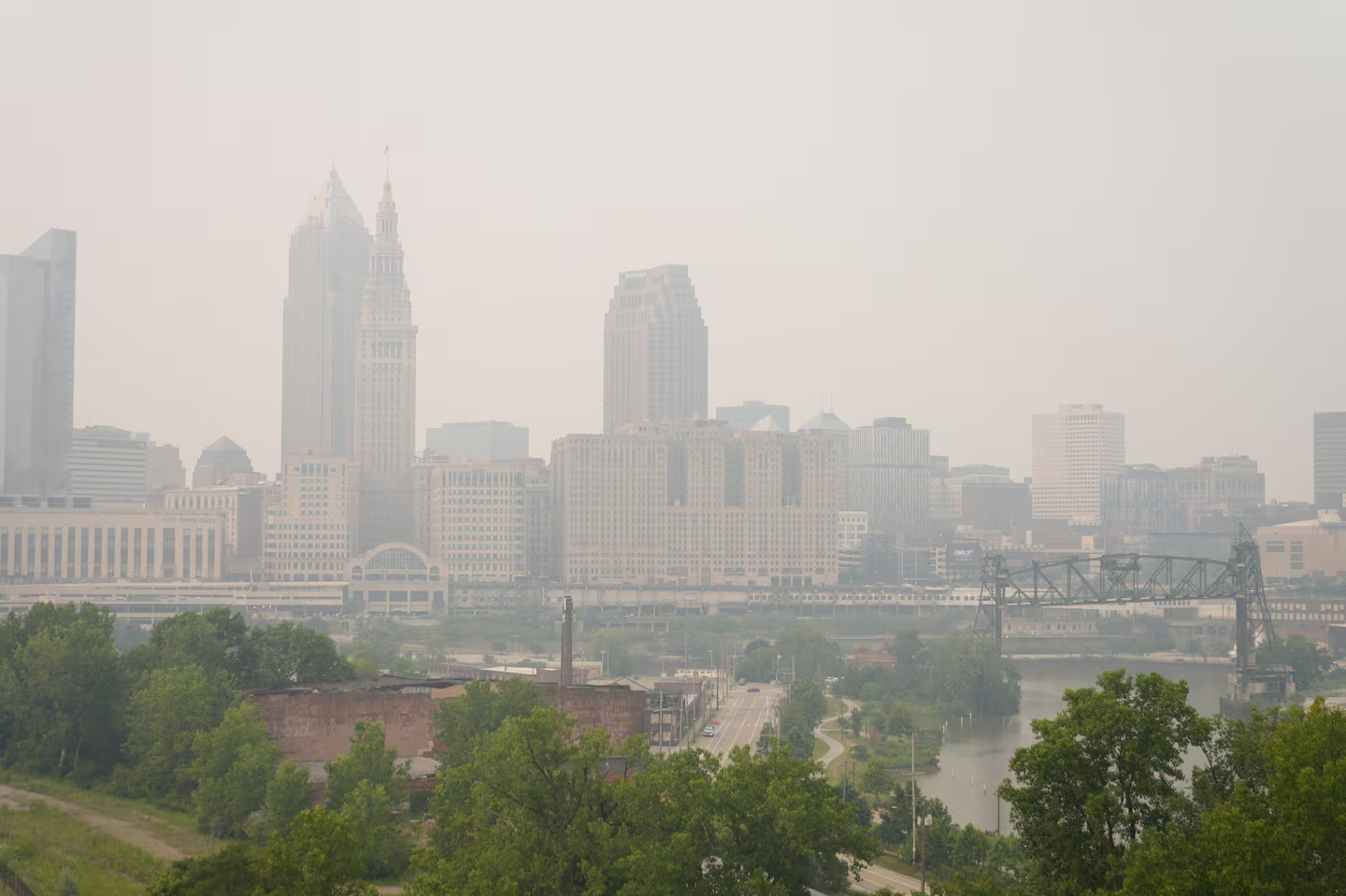
Meanwhile, the visual impact of the crisis has been striking. Landmarks like the Lincoln Memorial and Washington Monument were barely visible through heavy smoke in Arlington, Virginia, on July 17. In Cleveland, thick haze even forced the postponement of a Major League Baseball game between the Pirates and the Guardians.
Trump Blames Canada Over “Poisoned” Air
President Trump has taken a far more aggressive stance on the issue. He has publicly criticized Canada’s forest management practices, describing the smoke as a direct consequence of negligence.
In a Truth Social post on Friday, Trump wrote that the U.S. is “being unnecessarily invaded by filthy, polluted, and unhealthy air, the quality of which is dangerous, and totally unacceptable!” He specifically blamed Canada for “not properly maintaining their Forests, and Brush therein.”
Trump went further, framing the situation as a recurring financial burden. He described it as “Willful Negligence, and becoming a yearly occurrence, costing the United States Billions of Dollars, which cost of this pollution must of necessity be added to the TARIFFS Canada is currently paying.”
His comments arrive amid broader tension over tariffs between the two countries. As a result, wildfire smoke has become entangled with ongoing trade disputes, adding a new layer of complexity to an already strained relationship.
Notably, the smoke crisis isn’t limited to one direction. British Columbia has also issued recent air quality warnings, caused largely by wildfires burning across the United States. This shared vulnerability underscores how interconnected the two nations truly are when it comes to environmental threats.
A Long History of Cross-Border Wildfire Cooperation
Despite the current political friction, the U.S. and Canada have a well-documented history of helping each other during wildfire emergencies. This cooperation has often transcended politics entirely.
For instance, when wildfires raged across California in early 2025, Canadian firefighters were deployed to assist. In turn, American firefighters were sent north to support Canada during its own difficult 2025 wildfire season.
This mutual aid was formally acknowledged by U.S. Ambassador to Canada Pete Hoekstra in August 2025. He emphasized that the two nations “have a long history of supporting one another in times of crisis.”
Hoekstra also addressed the shared burden of poor air quality directly. “Poor air quality here in Ottawa, across Canada, and in the United States caused by the wildfires is a stark reminder of the shared challenges we face and the importance of working together to protect lives, communities, and natural resources,” he said.
He specifically credited Canada’s earlier support during the California wildfires. “Canadians stood with us during the tragic California wildfires earlier this year, and we are committed to standing with Canada now,” Hoekstra added.
Why This Debate Matters Now
This clash between Schiff and Trump reflects a larger question facing both countries: should wildfire smoke be treated as a shared natural disaster or a political bargaining chip? The answer may shape how future cross-border emergencies are handled.
Furthermore, as wildfire seasons intensify due to changing climate patterns, this issue is unlikely to disappear. Both nations will likely face repeated smoke events in the years ahead, making cooperation increasingly important.
For now, the divide remains clear. Trump continues to frame the smoke as a costly failure requiring financial consequences. Schiff, on the other hand, insists that humanity and historical goodwill should guide the response instead.
As air quality warnings persist across multiple U.S. states, the pressure on policymakers to find common ground is likely to grow. Whether that means renewed cooperation or continued political tension remains to be seen.