Canada Wildfire Smoke Tariffs: Trump Threatens New Tariff Hike Over Ontario Fires
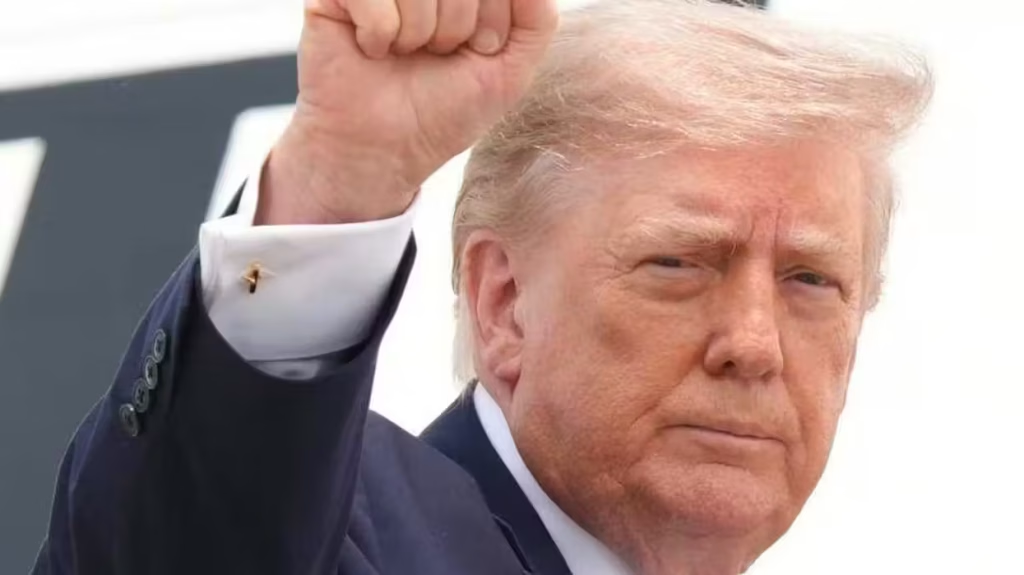
Canada wildfire smoke tariffs are back in the headlines after President Donald Trump threatened to raise duties on Canadian goods this week. The move comes as thick smoke from Ontario wildfires drifted across several U.S. states, triggering air quality alerts. Trump blamed Canada for poor forest management, and Republican lawmakers quickly joined in with their own criticism.
Trump Blames Canada for “Filthy” Air Quality
On Friday, Trump posted a sharp message on social media accusing Canada of neglecting its forests. He wrote that “We are holding Canada responsible for the fact that they are not properly maintaining their Forests, and Brush therein, and the United States is being unnecessarily invaded by filthy, polluted, and unhealthy air, the quality of which is dangerous, and totally unacceptable!”
The wildfires are burning through northwestern Ontario right now. As a result, several First Nations communities have been forced to evacuate. One remote community was completely destroyed, and residents had to flee by small boat to reach safety.
Smoke from these fires has since spread across the border. Consequently, air quality warnings are now active in Ontario and multiple U.S. states, including Michigan, Ohio, Illinois, New York, and Indiana.
Trump said he plans to call Prime Minister Mark Carney to address the situation directly. He accused Canada of “wilful negligence” and claimed the lack of forest management is costing the United States billions of dollars.
Legal Questions Around New Tariffs
It remains unclear which legal authority Trump would use to impose fresh tariffs on Canada. Earlier this year, the U.S. Supreme Court struck down his ability to use the International Emergency Economic Powers Act for his broader “Liberation Day” tariffs and fentanyl-related duties on Canada, Mexico, and China.
Currently, a 10 percent tariff on Canadian goods exists under Section 122 of the 1974 Trade Act. However, this measure was always meant to be temporary. It expires after 150 days, right at the end of July, unless Congress votes to extend it.
Notably, these tariffs do not apply to goods that comply with the Canada-U.S.-Mexico Agreement. Meanwhile, the Trump administration is also exploring Section 301 of the Trade Act of 1974. This approach would target forced labour concerns within global supply chains.
Interestingly, Trump’s tariff threat came just as he travelled to New York for a FIFA World Cup reception. Soccer officials are now watching closely to see whether the smoke will affect Sunday’s championship match in New Jersey.
Republican Lawmakers Push for Sanctions on Canada
This week, the wildfire smoke issue took a sharper political turn. Several Republican lawmakers stepped forward with strong criticism, and some even floated the idea of annexation-style threats against Canada.
Ohio Senator Bernie Moreno announced plans to introduce a bill next week that would sanction Canada over the smoke crisis. Specifically, the legislation would require the president to determine whether Canadian wildfires harmed U.S. air quality.
Additionally, the bill would sanction Canadian officials the U.S. holds responsible for the smoke. These sanctions could include revoking visas and “blocking assets,” among other measures. The bill would also “express a sense of Congress” that the Canadian ambassador is “persona non grata” until the smoke clears.
In an emailed statement, Moreno said, “My bill will declare an emergency, sanction all Canadian officials responsible, and study a victims compensation fund driven by imposing additional tariffs.”
Canada Pushes Back Against U.S. Criticism
During a Thursday news conference in London, Ontario, reporters asked Prime Minister Carney about the American criticism. He largely brushed off the comments and shifted focus toward energy policy instead.
Carney pointed out that Canada continues investing in clean energy, while the U.S. is actively working against similar initiatives. Speaking in French, he said, “Fighting climate change is the responsibility of all countries, including the United States.”
Meanwhile, Keith Stewart, a senior energy strategist at Greenpeace Canada, offered a broader perspective on the crisis. He noted that everyone pays the price when countries fail to act on climate change, since inaction makes wildfires burn hotter and spread faster.
In his emailed statement, Stewart said, “Any politician, on either side of the border, who is serious about dealing with this problem would be doubling down on wind and solar power, not subsidizing new oil pipelines, LNG facilities or data centres fuelled by fossil fuels.”
Ontario Responds With Frustration
Ontario Premier Doug Ford also weighed in on Friday. He confirmed that he spoke with two U.S. governors about sharing firefighting resources to help battle the ongoing blazes.
However, Ford expressed visible frustration with some of the criticism coming from American lawmakers. He reminded critics that Ontario sent water bombers to help fight devastating wildfires in California last year.
Furthermore, Ontario also sent linemen to assist after hurricanes hit multiple U.S. states. Ford explained, “A good neighbour, and I truly believe the Americans are good neighbours, if there’s some politicians out there chirping away, well, maybe what you should do rather than complain is send support, send help, because we have done the exact same thing for our American friends. And that’s that’s what you’re supposed to do.”
A Long History of Cross-Border Firefighting Cooperation
For decades, Canadian and American firefighters have worked side by side to battle wildfires in both countries. This cooperation carries real risk, and tragedy has struck recently on both sides of the border.
Sadly, a helicopter pilot from British Columbia died on Sunday while battling an uncontrolled fire in Colorado. Just last month, three other firefighters were also killed along the Colorado-Utah border, which drew fresh attention to wildfire safety policies.
That incident put a spotlight on the Trump administration’s approach to wildfire management. Specifically, officials have adopted a previously discredited strategy of fully suppressing every new fire rather than allowing controlled burns.
By contrast, Canada’s approach favors using fire strategically to clear old growth. This method reduces the fuel available for larger, more destructive blazes later on, and many experts consider it a more sustainable long-term solution.
What Happens Next
As the situation develops, several questions remain unanswered. Will Trump actually follow through on new Canada wildfire smoke tariffs, and if so, under what legal authority?
Additionally, the fate of Moreno’s proposed sanctions bill remains uncertain. Congress will need to decide whether to extend the current tariffs before they expire at the end of July.
For now, wildfire smoke continues to affect air quality across the Great Lakes region. Both governments will likely face continued pressure to address the immediate crisis while navigating a tense trade relationship.