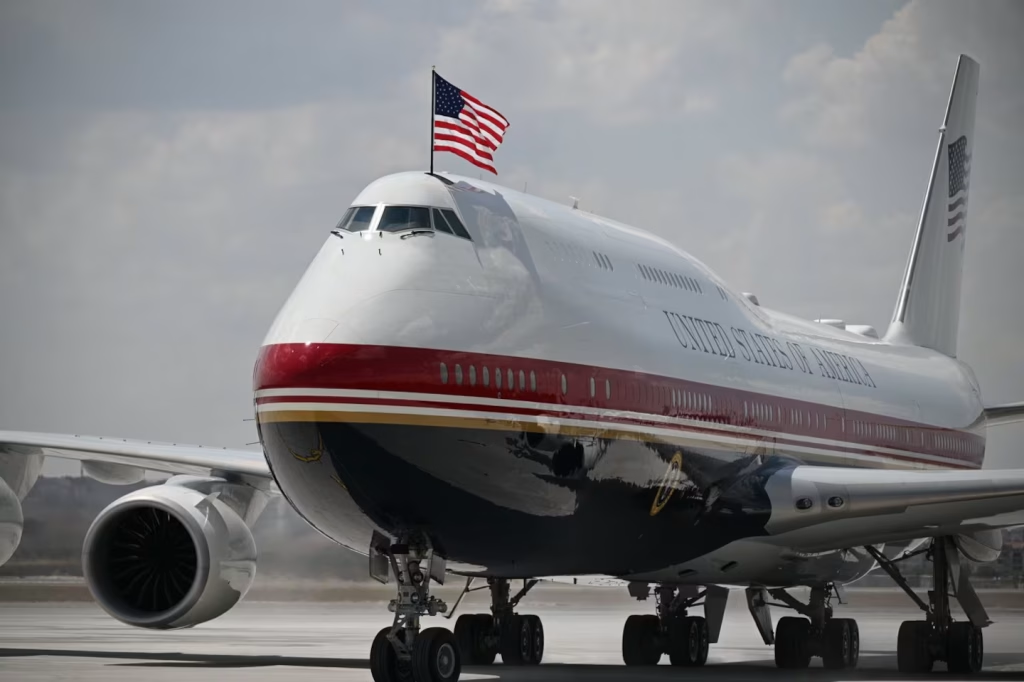
NYT Reporters Subpoenaed Over Air Force One Security Report
The NYT reporters subpoenaed this week are now at the center of a growing press freedom dispute. The Trump administration issued the subpoenas after the paper’s report on security concerns tied to the new Air Force One. Federal agents delivered several of the subpoenas directly to journalists at their homes. The move has sparked sharp criticism from press freedom advocates across the country.
Why the Subpoenas Were Issued
The subpoenas landed on Friday, and they order the reporters to testify before a federal grand jury in Manhattan on Wednesday. According to the New York Times, federal agents showed up at some reporters’ homes to deliver the documents in person. This approach is unusual, and it immediately drew attention from press freedom groups.
The dispute traces back to a Times report on the new Air Force One. President Donald Trump received the aircraft as a gift from Qatar, and it entered service last week following a $400 million retrofit. The report raised questions about whether the new plane had the same security features as the older Air Force One jets.
Neither the White House nor the Department of Justice responded to requests for comment on Saturday. However, the silence did little to calm the controversy. Meanwhile, the Times moved quickly to defend its journalists and the story itself.
David McCraw, a lawyer for the Times, condemned the tactic in strong terms. He said federal agents appearing at reporters’ doorsteps “should shock the conscience of any American.” His statement framed the subpoenas as a direct threat to constitutional press protections. As a result, the story has become about more than just Air Force One.
Trump’s Mid-Air Plane Swap Explained
The controversy grew out of an unusual sequence of events during Trump’s trip to a NATO summit in Turkey this week. Although the new jet flew him to the summit, he departed for England on one of the older Air Force One planes instead. The newer aircraft also flew to Mildenhall separately, and Trump switched planes again for the final leg home.
This plane swap happened at a tense moment. A shaky ceasefire with Iran had just collapsed, and the United States had launched airstrikes on Iranian targets. In turn, Tehran struck three Gulf Arab states. Since Iran and Turkey share a border, the timing fueled speculation about the new jet’s defenses.
Citing anonymous sources, the Times reported that the Secret Service urged the switch. The paper said the newer plane lacked some advanced security features found on the older jets, including antimissile capabilities. Naturally, this detail became the most contested part of the entire story.
Trump firmly denied any security concerns. Instead, he claimed on social media that the Mildenhall stop simply let service members view the new jet up close. During the flight home, he also told reporters that Iran-related security worries played no role in the two-plane arrangement. When asked about credible threats from Iran, he brushed the question aside rather than answering directly.
He did, however, acknowledge that threats against him are constant. As he put it, “I have a threat all the time. I’m No. 1 on their list.” The comment offered a rare glimpse into how seriously the administration treats his personal security. Still, it did not directly address the specific claims in the Times report.
Press Freedom Fallout and White House Response
The White House later pushed back firmly against any suggestion of security gaps. Spokesman Steven Cheung insisted the aircraft meets the highest standards available. He described it as “the new Air Force One is a state-of-the-art aircraft,” fitted with strong protective measures. Additionally, he pointed to the many threats the president reportedly faces and said the administration uses every available tool to counter them.
The journalists named in the subpoenas include Julian E. Barnes, Eric Lipton, Tyler Pager, and Eric Schmitt. All four contributed to the original reporting on the new Air Force One. Consequently, their testimony could become a major flashpoint in the broader fight over press protections.
This is not the first time this year that federal prosecutors have targeted major news organizations. Earlier in the year, the Justice Department subpoenaed reporters from The Washington Post and The Wall Street Journal. In both cases, however, officials later withdrew those subpoenas after public pressure mounted.
Given that pattern, many press freedom advocates expect a similar outcome here. Still, the optics of agents appearing at reporters’ homes have already intensified the debate over government overreach. Furthermore, the case raises fresh questions about how far federal authorities can go when pursuing leak investigations tied to national security reporting.
As the Wednesday grand jury date approaches, the situation remains fluid. Legal experts, journalism advocates, and lawmakers are all watching closely. Ultimately, the outcome could shape how future administrations handle friction between national security concerns and the press.