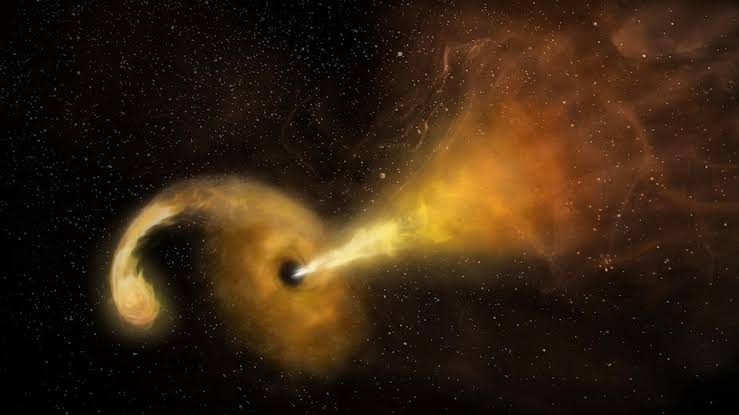
Black Hole Jets Explained: Why Black Holes Don't Eat Everything
Black hole jets rank among the most dramatic events in the universe. Yet scientists say a black hole is far from an efficient eater. In fact, a new study in the journal Nature Astronomy shows when these cosmic “burps” happen. As a result, astronomers now have a fresh way to watch some of the most extreme environments in space.
A black hole may be one of the universe’s most powerful objects. However, it does not swallow everything that comes near. Instead, it channels some of the surrounding gas outward. Two researchers now explain what triggers that process, and their answer could change how astronomers plan their work.
Catching a Black Hole in the Act
Adelle Goodwin, an astrophysicist at Curtin University in Western Australia, co-authored the study. She says black hole jets can grow enormous. In some cases, they even affect the galaxies that host them. Astronomers have puzzled over this for a long time.
Goodwin described the puzzle this way:
“I think one of the things that has puzzled astronomers for a really long time is that occasionally we see these supermassive black holes at the centre of galaxies, and they can power these really large, what we call jets or outflows, and these can be bigger than the galaxies themselves, so there’s all this gas that’s coming, being channeled by the black hole.”
The difficulty, however, is timing. These structures evolve over tens of thousands of years. Therefore, astronomers rarely catch the precise moment when a jet launches. That rarity makes every successful observation valuable.
Goodwin explains why catching that moment matters:
“Being able to catch these specific black holes that we were looking at in the act of burping or launching these jets and outflows allows us to really understand that physics, and learn how they can influence their host galaxies.”
Two Per Cent: The Trigger Behind Black Hole Jets
The team studied radio observations of black holes after stars were torn apart. They looked for patterns in when jets and outflows emerged. Interestingly, a clear pattern appeared. Black hole jets did not launch at random.
The study found that a crucial phase of jet activity begins after the feeding rate drops dramatically. That rate falls to about two per cent of its peak. Before that point, the black hole stays relatively quiet.
Andrew Mummery, an astrophysicist at the Institute for Advanced Study and study co-author, describes that quiet phase:
“So it seems quite quiet, it’s not launching a jet … so at that time it’s just feeding, it seems happy to just take all this matter from the disc.”
Then comes what the researchers describe as a critical trigger. Mummery added:
“And (when) you reach this magic number of two per cent … we know around all black holes of all sizes, there’s a trigger,”
Same Physics, Vastly Different Black Holes
One of the most striking aspects of the finding is its reach. The pattern appears to apply to black holes of dramatically different sizes. Goodwin said:
“What we’ve been able to show with this study is that these really large black holes that are millions to billions of times the mass of our sun, they launch jets and outflows at the same kind of feeding times or accretion rates as these small black holes,”
In other words, the underlying physics may be shared across an enormous range of black-hole sizes. Small and giant black holes seem to follow the same rule. This similarity gives scientists a powerful clue.
The discovery also helps astronomers plan their observations. Mummery explained why knowing the trigger matters:
“Understanding the conditions of which things happen is great because you can plan a bit better,”
“You can time your resources, your telescope time around watching this event in real time.”
Consequently, teams can point their telescopes at the right moment instead of guessing.
The finding could also help answer a much larger question. How did supermassive black holes become so massive? Goodwin said scientists understand the basic origins of smaller black holes. Their supermassive counterparts, however, present a much bigger puzzle:
“We fundamentally don’t understand how you go from a small black hole to a big black hole in the lifespan of the universe and the time available that the universe has been around.”
For Mummery, black hole jets raise another intriguing possibility. They may help researchers learn how quickly a black hole is spinning. Overall, this study turns cosmic burps into a useful tool. It gives astronomers a timer, a clue about shared physics, and a path toward bigger answers.