Canada US Trade Deal Could Come "Fairly Soon," Says Trump
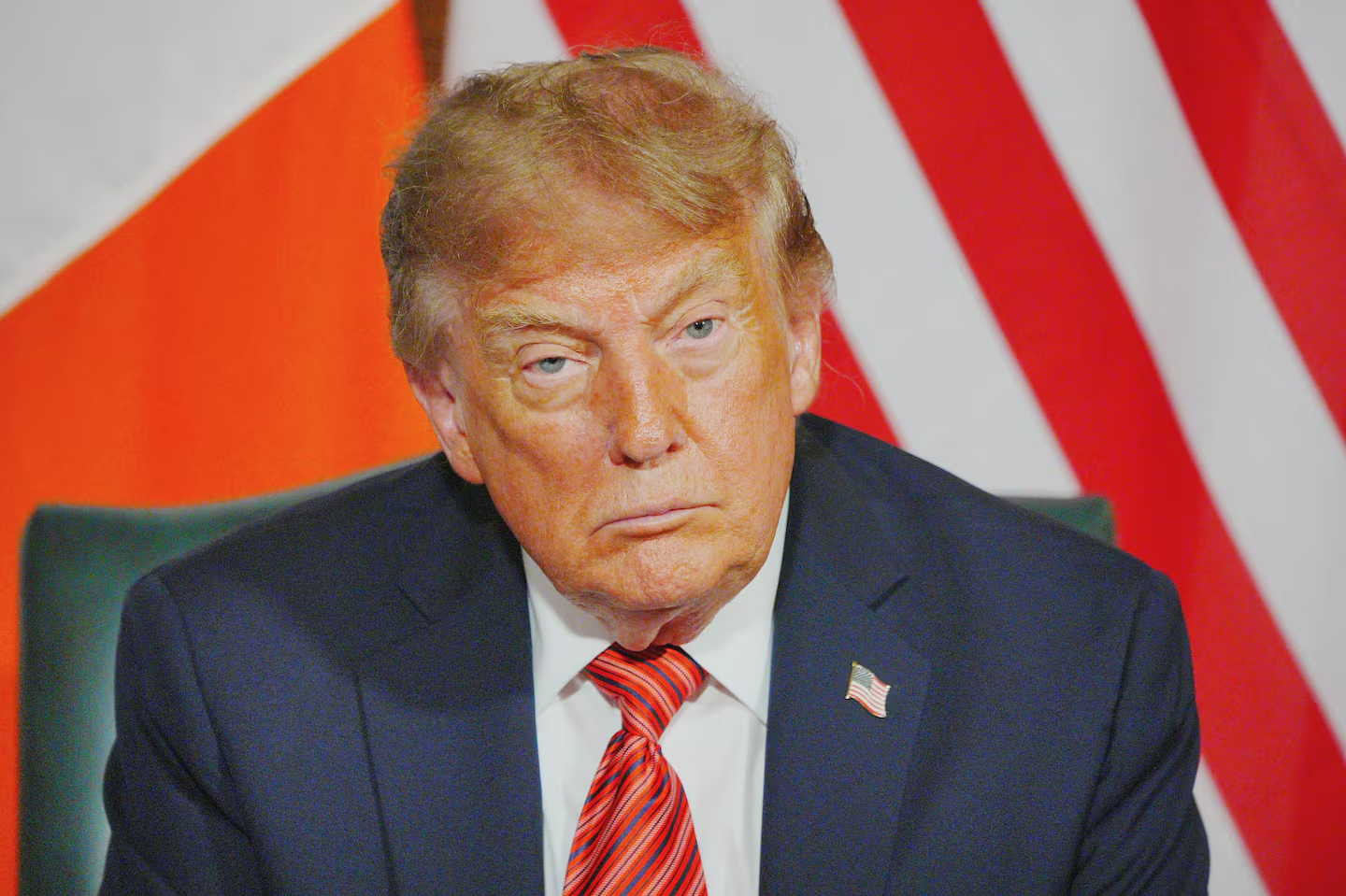
U.S. President Donald Trump believes a Canada US trade deal could be reached “fairly soon.” He made the remark while repeating his long-standing claim that the United States has been “ripped off” by its northern neighbour. Trump shared his comments during a press appearance in Ireland, alongside Taoiseach Micheál Martin.
A reporter asked whether Trump was considering pulling out of the Canada-U.S.-Mexico Agreement, known as CUSMA. In response, Trump downplayed the importance of Canadian trade to the U.S. economy.
“We’re going to have a great relationship with Mexico. We actually have a good one with Canada, but the United States has been ripped off for 50 years by Canada,” he said. He added, “We don’t need their product, and they need our product. They do all of their business almost with us and we do very little with them.”
Trump Repeats Long-Standing Trade Complaints
Trump’s comments come amid ongoing tension over trade between the two nations. However, the numbers tell a more complicated story than his statement suggests.
According to the U.S. Census Bureau, Canada exported $382 billion in goods to the United States in 2025. Meanwhile, Canada imported $334 billion in American goods that same year. A TD report further found that Canada was the United States’ second-largest trading partner in 2024, trailing only Mexico. In fact, 34 U.S. states sell more goods to Canada than to any other foreign economy.
Despite these figures, Trump continues to frame the relationship as one-sided. As a result, uncertainty around the Canada US trade deal remains high heading into the fall.
CUSMA Review and Breakdown of Talks
Canada, the U.S., and Mexico have been negotiating several trade matters throughout the year. CUSMA came up for its regular review over the summer. Instead of renewing the agreement outright, the three countries agreed to participate in annual surveys while the deal itself stays in place.
Formal negotiations between Canada and the U.S. broke down on August 21. Prime Minister Mark Carney called his delegation home from Ottawa that day. He said the U.S. had introduced new and unacceptable requirements at the last minute. American officials, on the other hand, blamed Canada for the impasse.
Ralph Goodale, a member of Carney’s Canada-U.S. trade advisory group, weighed in on the collapse. He called the American offer “one sided” and “fundamentally uneconomic” during an interview with CTV News Channel.
Even so, trade negotiators from both countries appear to be talking behind the scenes. Following the breakdown, Trump imposed 50 per cent tariffs on nearly $28 billion worth of Canadian goods. Canada responded with retaliatory tariffs that took effect the following Tuesday.
That same day, Trump signed new orders banning imports of several Canadian products, including most alcohol. He also adjusted the tariff list, adding some items while removing others, such as toilet paper, cement, and road salt.
Agriculture Tariffs Add Fuel to the Dispute
Trump also targeted Canada’s agricultural sector during his Saturday remarks. He claimed Canadian farmers were charging U.S. producers “400 per cent tariffs.” This appeared to reference Canada’s supply management system, which regulates how much of certain agricultural goods can enter the country.
Products like eggs, turkey, chicken, and dairy fall under this system. A set quota of these goods can enter Canada with low or no tariffs. Once that quota is exceeded, however, importers face steep levies on additional shipments.
Goodale pushed back strongly against Trump’s framing. He called the president’s characterization “factually wrong” and “part of the PR game.” Therefore, the accuracy of Trump’s tariff claims remains disputed by Canadian officials.
Is Canada Being Treated as an “Enemy?”
Trump also touched on broader foreign policy during his remarks. “Canada wants to make a deal very badly,” he told reporters, before shifting to comment on Iran. “Canada wants to make a deal, and Iran wants to make a deal. And at the right time both of those things could happen,” he said. He added that he hopes “Canada appreciates being in the same sentence with Iran.”
CTV News political commentator Scott Reid criticized the comparison sharply. He said Trump’s inclusion of Iran “really speaks to the destructive nature of Donald Trump’s foreign policy.” Reid, who previously served as communications director to former Prime Minister Paul Martin, went further still.
“We are now treated expressly as an enemy,” Reid said. He suggested Trump’s remarks could actually “stiffen the spine” of Canadians evaluating a future trade deal with Washington.
What Comes Next for a Canada US Trade Deal
Policy and advocacy strategist Diamond Isinger, who previously advised former Prime Minister Justin Trudeau during NAFTA renegotiations, offered a more cautious read. “It’s hard to keep up with the ups and downs of the Canada-U.S. dynamic right now,” she said.
Although tensions appear to have cooled slightly, Isinger still has reservations about how talks might resume. She noted that expecting Canada to simply pick up where talks left off would be unrealistic. “If they (the U.S.) simply would like to resume talks at the same starting point things were severed, those were not realistic expectations for Canada to agree to,” she said.
Ultimately, she suggested any real progress will require the U.S. to shift its current position. Until that happens, the future of a finalized Canada US trade deal remains uncertain for businesses and consumers on both sides of the border.