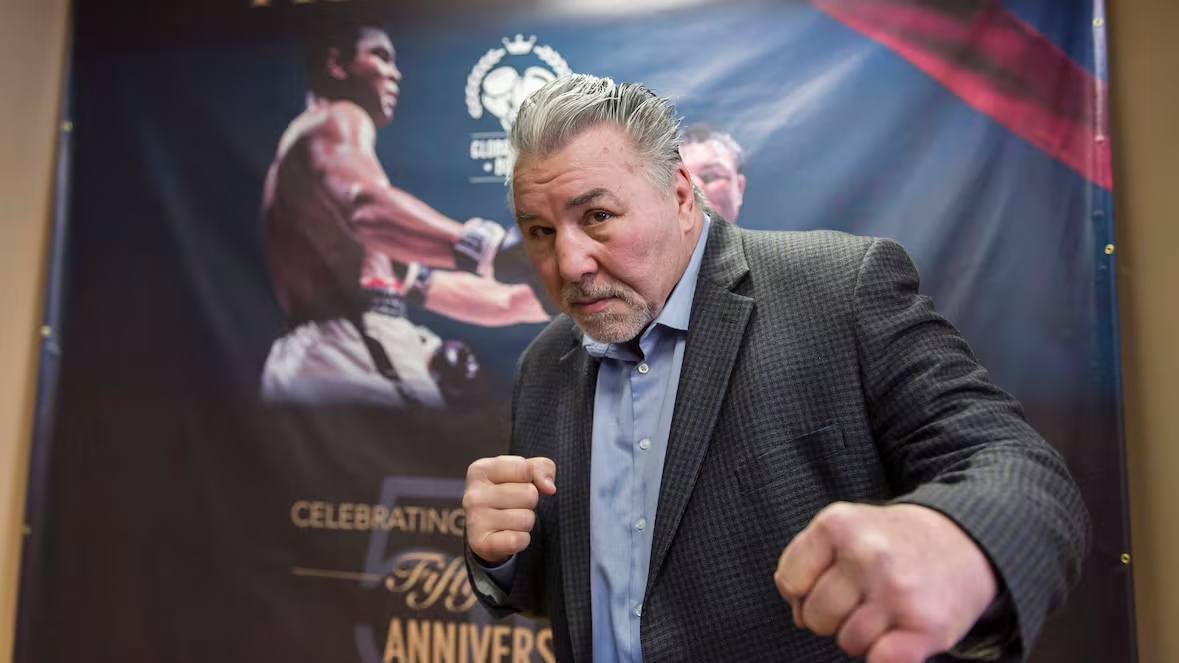
George Chuvalo Dies at 89: Canadian Boxing Icon Who Battled Muhammad Ali
George Chuvalo dies at 89, closing the chapter on one of Canada’s toughest sporting legends. The iron-chinned heavyweight was famous for taking the hardest punches boxing had to offer without ever hitting the canvas. He passed away in Toronto, where he had been living in a long-term care facility due to dementia.
Chuvalo’s death was confirmed Saturday through multiple posts from family and friends. Ontario Premier Doug Ford, who called the boxer a close family friend, shared his condolences on social media. “My thoughts are with all of George’s family and loved ones as we mourn his passing,” Ford said.
Although Chuvalo never won a world title, he built a legacy that outlasted many champions. He went the distance with Muhammad Ali twice and absorbed brutal shots from legends like Joe Frazier and George Foreman. Remarkably, he was never knocked down in his entire professional career.
A Rise Built on Grit and Determination
Born on September 12, 1937, in Toronto’s Junction neighbourhood, Chuvalo was the son of Croatian immigrants. His interest in boxing began after he spotted a copy of The Ring magazine at a local newsstand. From there, his path into the sport felt almost inevitable.
He stepped into the ring for the first time at just 10 years old. A sudden growth spurt, combined with serious weightlifting, transformed him into a powerful six-foot, 210-pound fighter. Consequently, he stood out early as a physical force to be reckoned with.
Chuvalo turned professional in 1956 and quickly gained attention at the Jack Dempsey Tournament in Maple Leaf Gardens. However, his career stalled during the early 1960s under poor management. Everything changed when Toronto poultry magnate Irv Ungerman stepped in to guide his career.
Under new management, Chuvalo scored a statement win over contender Doug Jones at Madison Square Garden in 1964. He returned the following year and narrowly lost a decision to former champion Floyd Patterson. The Ring magazine later named that bout the best fight of 1965.
“He Just Keeps Coming and Coming”
Chuvalo’s fighting style was relentless but never careless. He pressed forward constantly, landing heavy blows to the head and body with both hands. As a result, he finished 88 per cent of his wins by stoppage.
Fellow Canadian fighter Bill Drover once summed up the frustration of facing him. “You can’t believe his strength,” Drover said. “There’s no way to stop him. He just keeps coming and coming. The only way you can stop him is with a stick of dynamite.”
Chuvalo always insisted his defensive skills were underrated by critics. Still, it was his extraordinary durability that truly set him apart. He credited part of that toughness to a 17.5-inch neck, which he strengthened through dedicated exercises.
Facing Muhammad Ali and Boxing’s Biggest Names
In 1966, Chuvalo earned a shot at boxing’s biggest prize. He stepped in as a replacement opponent for Ali, whose ties to the Black Muslims and opposition to the Vietnam War had made him a controversial figure in the United States. Few expected Chuvalo to compete.
A New York Times headline captured the low expectations bluntly, describing him as “A Big Bum With a Lot of Heart.” Despite the odds, Chuvalo delivered a gritty, punishing performance that lasted a full 15 rounds. He never came close to hitting the canvas.
Although he failed to become Canada’s first heavyweight champion since Tommy Burns, the fight defined his career. Ali later called him the toughest opponent he had faced up to that point. Chuvalo, however, admitted it took years before he fully appreciated the significance.
“In a crazy way, that fight is what defines me for a lot of my fellow Canadians,” he said, “but it took a long time before I came to appreciate how good it made me feel.” Meanwhile, the payday from the bout allowed him to support his wife, Lynne, and their five children.
He went on to defeat contenders Jerry Quarry and Manuel Ramos in the years that followed. On the other hand, he suffered close, hard-fought losses to Oscar Bonavena and Jimmy Ellis. Additionally, Frazier stopped him for the first time in 1967, an injury requiring a silicone implant for his eye.
Three years later, Foreman also stopped Chuvalo, this time in the fourth round. The referee intervened before his famous “never knocked down” streak could officially end. Even so, Chuvalo’s toughness against boxing’s most feared punchers remained legendary.
His final bout with Ali, held in Vancouver in 1972, lacked the drama of their first meeting. Chuvalo eventually retired in 1978 on a winning note. He finished his career with 73 wins, 18 losses, and two draws, including 64 knockout victories.
Life After the Ring and Personal Tragedy
Unlike many of his opponents, Chuvalo showed few outward signs of damage from his brutal career. He remained sharp, articulate, and quick with a self-deprecating joke. Nevertheless, adjusting to ordinary life outside the ring proved difficult for him.
He tried his hand at several ventures after retiring, including opening a nightclub and earning a real estate licence. He also promoted fights, hosted a television show, and even appeared in David Cronenberg’s film The Fly. Still, nothing could prepare him for the tragedy that followed.
In 1968, Chuvalo told CBC Radio that he never wanted his sons to box professionally. Tragically, it was outside the ring where real danger awaited his family. His youngest son, Jesse, became addicted to heroin after a prescription for pain medication ran out.
Jesse died by suicide in 1985 at just 19 years old. Not long after, his older brothers George Jr. and Steven also became addicted to heroin and turned to petty crime. Steven later described the deep sense of “worthlessness” that gripped all three brothers during that period.
“My dad spent quite a few years chasing us around the city, Georgie and I in particular, and dragging us out of drug houses and heroin houses and basically just trying to keep us alive,” Steven said in a 1995 interview with CBC’s the fifth estate.
George Jr. died of an overdose on Halloween in 1993, only days after being released from jail. Just four days later, 49-year-old Lynne Chuvalo took her own life, leaving behind a suicide note. “I never thought she’d do it, but I’m not surprised,” Chuvalo told the New York Times afterward.
Steven, who had spoken openly about wanting to make his father proud, died of an overdose eight months after that interview aired. Despite these devastating losses, Chuvalo eventually remarried and rebuilt his life. He found comfort in his surviving children, Mitch and Vanessa, along with his grandchildren.
In later years, Chuvalo travelled across Canada speaking candidly to students about addiction. His message remained simple and deeply personal every time he spoke. “I’d like to think if you’re ever tempted with the idea of doing drugs, or you ever flirt with doing drugs, I hope you think of me, George Chuvalo, and what drugs did to my family.”
A Legacy of Toughness and Honesty
As news of his passing spreads, tributes continue pouring in from across the boxing world. George Chuvalo dies at 89, but his story of resilience — both inside and outside the ring — remains unforgettable. He will be remembered not only as a fighter who never fell, but as a father who never stopped trying to save his family.