These Provinces Could See the Most Job Losses From New U.S. Tariffs, Report Finds
Inside a small children’s store in Toronto, owner Jill Rochon slaps on new price tags to goods she recently imported from the U.S. She laughs and chats with her lone employee that day, Zoe Tilups. It is an ordinary afternoon. However, it may not stay that way for long.
New analysis on U.S. tariffs job losses estimates that nearly 90,000 Canadian jobs could be affected once 50 per cent U.S. tariffs take hold. Ontario, Quebec and British Columbia face the biggest potential losses. Meanwhile, small business owners like Rochon are already bracing for the fallout.
Rochon and Tilups are more than employer and employee. They admit they are more like friends, since Tilups has worked at Jill and the Beanstalk toy store for more than six years. As a result, the possibility of layoffs feels personal, not just financial.
The future of their friendship may be on shaky ground. New U.S. tariffs and Canada’s proposed “dollar-for-dollar” counter-tariffs are expected to increase costs for Rochon. Consequently, she may have no choice but to lay off Tilups and other staff members.
“If I had to let them go, I would have to let them go,” Rochon told CTV News Sunday. “I feel very strongly for them, so I’d have a really hard time doing that, but yeah, I would have to let staff go if we come up with that [shortfall.]”
How Many Jobs Are Actually at Risk
Economist Trevor Tombe of the University of Calgary has produced one of the most detailed breakdowns of the coming impact. His analysis estimates that approximately 52,000 jobs are directly at risk. In addition, indirect effects on Canadian suppliers and service providers could put another 35,000 positions in jeopardy.
Together, that adds up to almost 90,000 jobs nationwide. This figure captures both the workers who make tariffed goods and the wider web of businesses that support them. Therefore, the true scale of the damage extends far beyond the factory floor.
“If we assume that these tariffs remain in place for some time, what it effectively means is that Americans will be purchasing fewer of the tariff items from Canadian producers — and that will mean less output in Canada and therefore less employment in those exporting firms,” said Tombe.
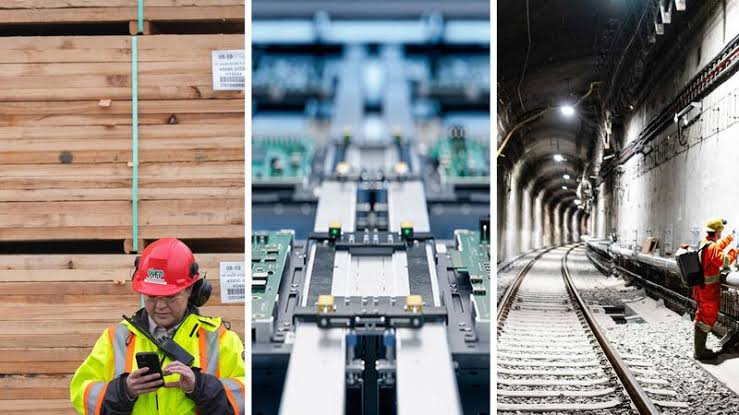
The hardest-hit sectors include machinery, electronics, plastics and rubber. Furniture, toys, wood products, chemicals, food products and clothing also rank among the most exposed industries. Notably, roughly half of Canada’s textile exports to the U.S. would be affected by the new levies.
Which Provinces Face the Biggest Losses
Ontario is projected to absorb the heaviest blow, with an estimated 36,100 jobs at risk. Quebec follows with roughly 18,300 potential job losses. British Columbia rounds out the top three, facing an estimated 11,200 losses tied largely to its export sectors.
“B.C. is heavily exposed to component circuit board type electronics that are exported to the United States, but also wood products,” said Tombe. “This is something that’s quite important for B.C.”
Alberta, meanwhile, presents a more surprising case. Although its direct exports are barely touched by the new tariffs, the province could still see around 9,000 jobs disappear. This happens because Alberta’s service sector supports exporters located elsewhere in the country.
That ripple effect will not stop at Alberta’s border. Economists warn that provinces without heavy manufacturing exposure could still feel the pinch as the broader economy slows down. Consequently, no region is entirely insulated from the fallout.
“Because we have a lot of interprovincial trade here in Canada, with broader economic slowdowns, you will start to see job losses in places like Alberta, Saskatchewan (and) the Maritimes as well, because we’ll have this broader reduction in economic activity,” said economist Colin Mang in an interview with CTV News Sunday.
Statistics Canada released its latest snapshot of the job market the same morning these projections emerged. The timing underscored how closely tied Canada’s labour data now is to developments south of the border. As a result, economists are watching monthly job reports more closely than usual.
Small Businesses Feel the Squeeze First
For owners like Rochon, these projections are not abstract percentages on a chart. They translate directly into difficult conversations with people she considers friends. Similarly, thousands of other small business owners across Ontario, Quebec and B.C. face the same painful calculations.
Rising costs from tariffs and counter-tariffs squeeze already thin retail margins. Consequently, many independent shop owners say layoffs may become unavoidable if the trade dispute drags on. For now, though, Rochon is simply hoping it never comes to that point.
Her situation captures the human dimension behind the economic modelling. Behind every job-loss estimate sits a real employee, a real paycheque and a real relationship built over years. Ultimately, that is what makes this report resonate beyond spreadsheets and forecasts.