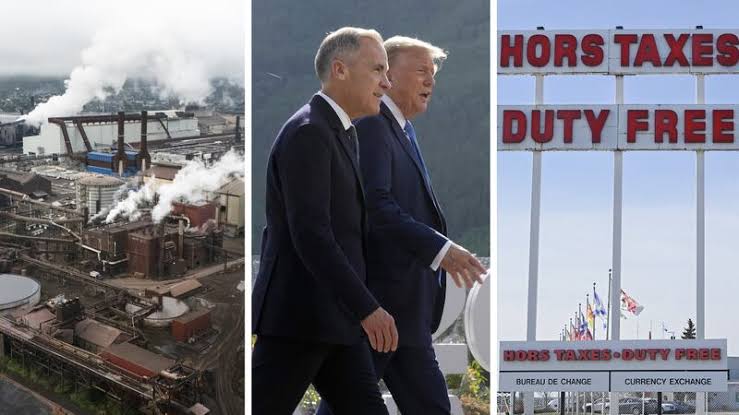
Trump Auto Tariffs: 50% Hike on Cars, Trucks Set for New Year's Day
Trump auto tariffs are back in the headlines. U.S. President Donald Trump has threatened to raise duties on all cars, trucks, and auto parts to 50 per cent starting New Year’s Day. The move follows a sudden collapse in trade talks between Washington and Ottawa. As a result, businesses on both sides of the border are bracing for fresh disruption.
Meanwhile, Canadian officials are scrambling to respond. Conservative Leader Pierre Poilievre wants Parliament reconvened immediately. In addition, a fresh economic analysis suggests roughly 87,000 Canadian jobs could be at risk if the trade war drags on. Below, we break down the latest developments in this fast-moving story.
Trump Announces 50% Auto Tariffs on Canada
Trump made the announcement in a Truth Social post on Monday. He said the higher rate would apply to “all Cars, Trucks, both large and small, Automotive Parts, and Steel.” According to Trump, companies that build in the U.S. will face “ZERO TARIFFS.”
He didn’t stop there. Trump also accused Canada of feeling “entitled” and claimed the country is “among the worst Nations in the World to deal with.” Furthermore, he argued the trade relationship overwhelmingly favours Canada, stating “THEY NEED US! They do 95% of their business with the U.S., with us, the exact opposite!”
However, U.S. Trade Representative Jamieson Greer downplayed the fallout. He called the situation “a little bit of a tempest in a teapot” while speaking to reporters. Greer noted the new tariffs only affect “about 5% of Canadian trade, only .06 percent of U.S. overall consumption.” Still, he confirmed he’s preparing options for Trump in case Canada follows through on threats to retaliate dollar-for-dollar.
Trump’s Truth Social claims echo a pattern of prior trade-war rhetoric aimed at pressuring Ottawa back to the negotiating table.
The Breakdown That Started It All
The escalation began after Prime Minister Mark Carney recalled Canadian negotiators from Washington. Consequently, the U.S. moved quickly to impose fresh duties on billions of dollars in Canadian exports. In his own address, Carney said Canada is now at economic “war” with the United States, blaming last-minute changes to the proposed deal.
Trump, for his part, insists Canada has “charged U.S. farmers ‘massive amounts of tariffs’ for many years.” Yet the Dairy Farmers of Canada pushed back on that framing. The group explained that countries exporting to Canada “will not pay the high tariff because they will simply not export more than was negotiated in the trade agreement under which they have access.”
Canadian Reaction: Job Losses and Political Fallout
The political response in Ottawa has been swift. Poilievre wrote directly to Carney, arguing “we must put the national interest first.” He also warned that “the failure to secure a durable trade agreement, together with escalating tariffs, now threatens deeper economic pain on top of a decade of rising costs and zero economic growth in the Canadian economy.”
Other parties are demanding more transparency too. Canada-U.S. relations critic Shuvaloy Majumdar asked the government to release the full trade offer, saying “Canadians deserve to see it.” Similarly, Green Party Leader Elizabeth May called for a briefing, suggesting “we should have at least a Zoom call or Teams meeting.”
Former Conservative deputy leader Lisa Raitt echoed the call for openness. “Having other folks leak and talk to reporters, it’s not helpful,” she told CTV News Channel. “It’s openness that’s needed.”
Which Provinces Face the Biggest Hit?
According to University of Calgary economics professor Trevor Tombe, roughly 87,000 Canadian jobs are at risk. His analysis, based on Statistics Canada data, estimates 52,000 jobs are directly threatened, while indirect effects could put another 35,000 at risk.
Ontario is projected to lose the most jobs at 36,100, followed by Quebec at 18,300 and British Columbia at 11,200. Machinery, electronics, plastics, and rubber industries are expected to feel the heaviest blow. “What it effectively means is that Americans will be purchasing fewer of the tariff items from Canadian producers,” Tombe explained.
Provincial leaders, meanwhile, are urging residents to buy local. P.E.I. Premier Rob Lantz said “every dollar spent on an Island or Canadian product supports the worker who made it.” New Brunswick Premier Susan Holt added that the province needs to “double down on buying local.” Quebec Premier Christine Frechette went further, calling local purchases “an action of solidarity.”
Trade War Ripple Effects Across Industries
The economic strain isn’t limited to auto manufacturing. Canadian Manufacturers & Exporters president Dennis Darby told CTV Your Morning that manufacturing investment has already dropped by about a third compared to last year. He called it “a bad omen” for both countries, noting that “companies aren’t investing for the future” on top of production slowdowns.
The aluminium sector is also feeling the pressure. Jean Simard of the Aluminium Association of Canada explained that Canada exports 90 per cent of its 3.3 million tonnes of annual aluminium production, with 90 per cent of that going to the U.S. As a result, American customers are “paying the full brunt of the tariffs,” paying $1,500 to $2,000 more per tonne than European buyers.
Small businesses are especially exposed. B.C. Chamber of Commerce president Jen Riley said “job loss is inevitable,” adding that her organization has tracked “15 changes over the last 21 months” in trade policy. She warned that many small and medium businesses “are not going to be able to make it out of this.”
Trade lawyer Ljiljana Stanić of McCarthy Tétrault said the collapse of talks was “unexpected,” noting most observers had anticipated another extension. She believes the U.S. was effectively trying to build a “fortress North America,” which she called “a lot to ask from Canada without having free trade with the United States.”
Even everyday communities are feeling the impact. A Minnesota school raising funds for a mascot costume was hit with a surprise $7,000 price increase tied to the tariffs. Parent Sarah Kallal said she was floored to learn the cause, noting “it brings awareness to how it’s not going to just affect corporations and government.”
Public Backlash Grows
Frustration is also spilling into public spaces. Fans booed the American national anthem at MLS games in both Vancouver and Montreal over the weekend. The protests came just hours after Carney suspended trade talks and recalled negotiators.
U.S. Transportation Secretary Sean Duffy dismissed the idea that Canada could win a prolonged trade fight. He said Carney would return to the table “very very quickly, because it’s going to be devastating for his country.” Duffy added, “to think that they’re going to go to war with Donald Trump and actually win that war with the U.S., I think it’s foolish on their part.”
What Happens Next?
For now, the situation remains fluid. Both governments appear dug in, and the proposed 50 per cent tariffs are set to take effect on New Year’s Day unless talks resume. Meanwhile, Canadian workers, exporters, and small businesses continue to absorb the uncertainty.
We want to hear from you. Are you worried about how these tariffs might affect your work? Have trade disruptions already impacted your job? Follow this page for continuing live updates on the Canada-U.S. trade war.