Carney Trade Deal Collapse: Why Canada Walked Away From the U.S. — and What Happens Next
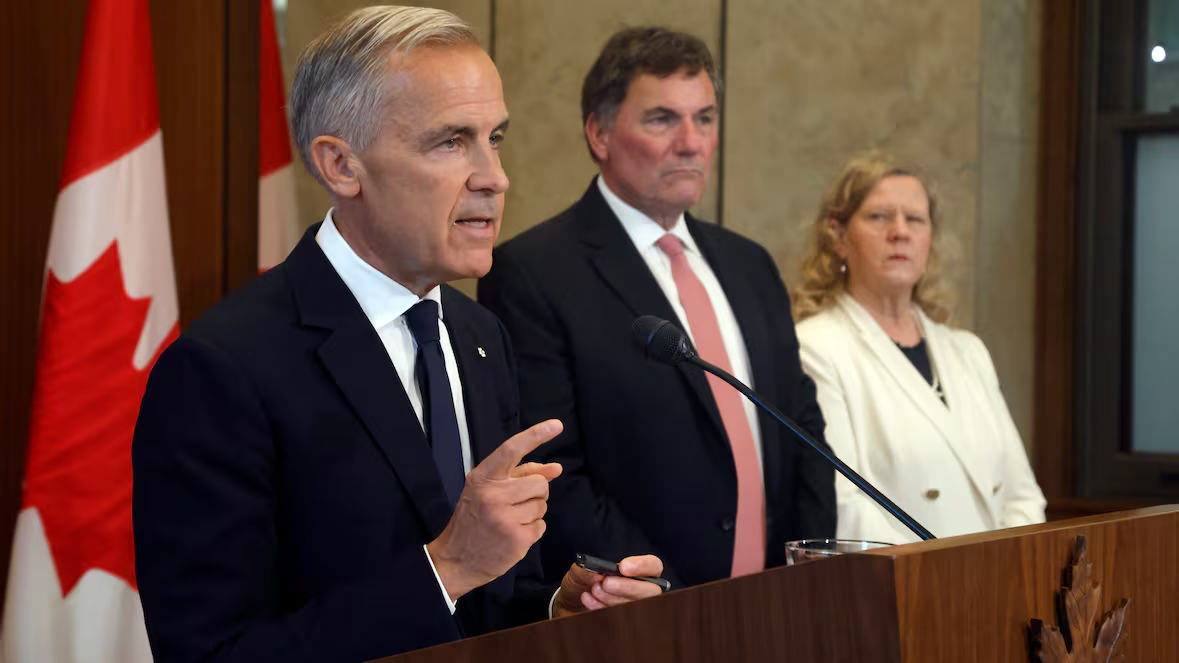
The Carney trade deal collapse has left Canada and the United States staring at each other across a diplomatic cliff edge. Prime Minister Mark Carney announced on Saturday that Canada was “walking away from a bad deal,” ending more than a year of negotiations. As a result, new U.S. tariffs on Canadian goods took effect at 12:01 a.m. Saturday, and thousands of Canadian jobs now hang in the balance.
Why the Trade Deal Fell Apart
For over a year, Canadian negotiators worked steadily to secure a comprehensive agreement with Washington. Carney said his government had been “pragmatic, patient and persistent” throughout the process. However, that patience apparently was not enough to satisfy American negotiators in the final hours.
In a statement released just 20 minutes before midnight on Friday, Carney explained that “last-minute changes” to the proposed terms were “unfair, uneconomic, and called into question the reliability of any deal.” Meanwhile, U.S. Trade Representative Jamieson Greer had already told reporters that Canada had “declined to finalize” the agreement.
Carney later outlined three specific sticking points to reporters. American negotiators had tried to change the scope of tariffs on Canadian auto content. In addition, they attempted to restrict Canada’s ability to sign trade deals with other countries. Finally, they pushed to limit Canada’s protections around language and culture, which Carney said threatened, “in effect, our sovereignty.”
Steve Verheul, Canada’s former chief negotiator, was reportedly worried that Canada had already conceded too much before talks broke down. Similarly, former foreign affairs minister Chrystia Freeland cautioned that accepting the U.S. tariffs, even implicitly, would cross a point of no return. Still, it remains fair to ask whether any realistic path forward could avoid that outcome altogether, given the pattern of Donald Trump’s other recent trade agreements.
America’s New Playbook: “You Can’t Take Us for Granted”
The breakdown in talks did not happen in isolation. It reflects a broader shift in how the Trump administration views its global partnerships. A senior official told the New York Times in July that American foreign policy now rests on the idea that “people can no longer take the United States for granted.”
Elbridge Colby, a senior adviser to the secretary of war, described this approach as an effort to “accurately price the partnership and relationship with the United States.” According to Colby, this applies to everything from AI and energy access to burden-sharing and tariffs. Consequently, allies that once assumed steady cooperation now face constant renegotiation.
This shift carries real consequences for Canadian workers. Economist Trevor Tombe of the University of Calgary estimated that as many as 90,000 Canadians could lose their jobs because of the new tariffs. Furthermore, Janice Charette, Canada’s current chief negotiator, had already warned her American counterparts that new tariffs risked creating a “cliff” for the entire negotiation process.
Conservative strategist Kory Teneycke offered a blunt analogy on the Herle Burly podcast. He argued that long-term trade agreements are effectively over. As he put it, “We’re managing a chronic disease. This is diabetes… We’re going to be doing insulin checks and taking injections on a daily basis for as long as this administration’s around.”
Patrick Leblond, a business and public policy professor at the University of Ottawa, compared the standoff to two drivers racing toward each other in a game of chicken. Therefore, neither analogy — chronic illness or vehicular collision — suggests a comfortable road ahead for Canada-U.S. relations.
What Comes Next for Canada and the U.S.
Speaking on Saturday, Carney insisted his government had been “under no illusions” about the changing relationship. “We recognized from the start that America has changed,” he told reporters. Officials reportedly anticipated that Washington would “transform all of its commercial relationships” and “use economic integration as a weapon.”
Despite this awareness, Carney maintained that Canada still tried to “strike a fair deal on which Canadian businesses and workers could rely.” He added that he believes people on both sides of the border genuinely want the relationship to work. Nonetheless, he said the “cumulative effect of U.S. demands” ultimately “revealed the limits” of Washington’s commitment to a true economic partnership.
Ontario Premier Doug Ford backed Carney’s decision, calling the proposed agreement a “bad deal” for the province’s steel and auto sectors. Ford said Ontario would now focus on supporting workers and businesses affected by the new 50% tariff. Similarly, Carney has repeatedly argued that “no deal is better than a bad deal.”
Looking ahead, several questions remain unresolved. Will the Trump administration escalate further if Canada introduces counter-tariffs after Labour Day? What conditions might bring both sides back to the negotiating table? For now, Canadians are left waiting for clearer answers from their leaders about what comes next.
The Bottom Line
The Carney trade deal collapse marks a turning point in Canada-U.S. relations, not just a temporary setback. Both governments now face pressure to manage economic fallout while searching for a path back to the table. As tariffs take hold and counter-tariffs loom after Labour Day, the coming weeks will show whether pragmatism or confrontation defines this new chapter.