Canada-US Trade Deal Collapses as Carney Says U.S. 'Asked Too Much and Offered Too Little'
The Canada-US trade deal fell apart this weekend after Prime Minister Mark Carney pulled Canadian negotiators off the table. According to Carney, late demands from the Trump administration on culture, autos, and sovereignty made the agreement impossible to accept. As a result, 50 per cent tariffs on a wide range of Canadian goods took effect at 12:01 a.m. Saturday.
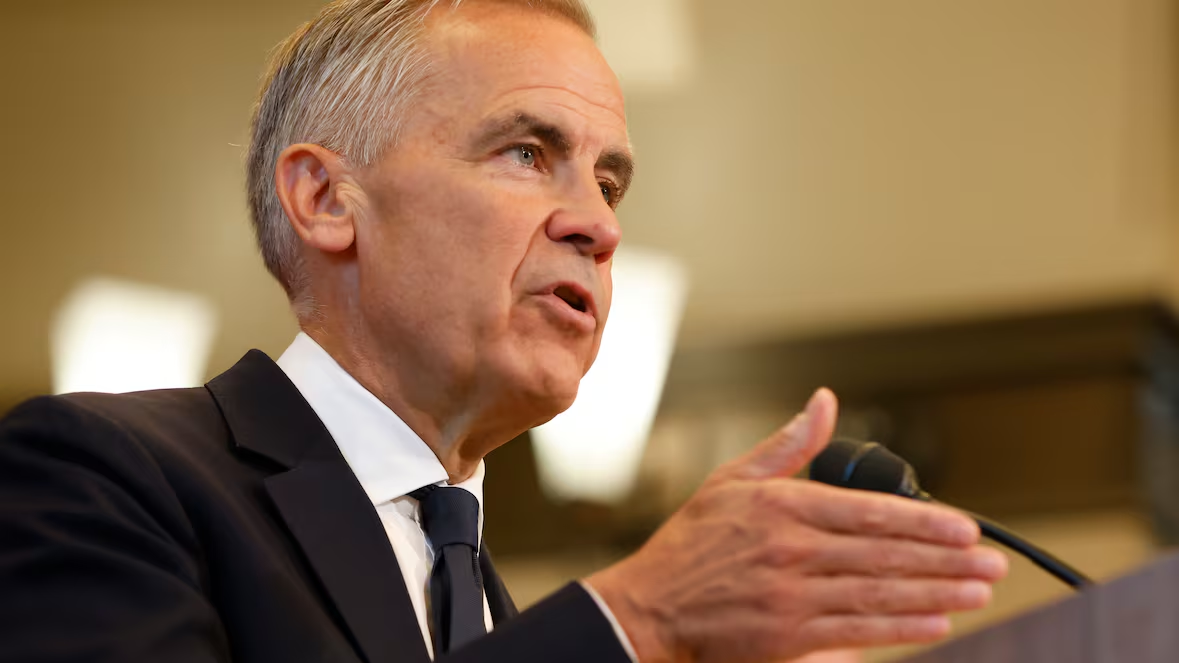
Speaking in Ottawa, Carney did not hold back. “We cannot accept what they’ve offered, and we will not give what they’ve asked,” he said. He added that the United States “asked too much and offered too little.” This marked a sharp departure from his usually diplomatic tone.
Why Carney Walked Away From the Table
Carney explained that months of negotiation had been building toward a fair, if imperfect, outcome. However, last-minute changes from the American side undid that progress entirely. He described three specific sticking points: auto tariffs, restrictions on Canada’s freedom to sign other trade deals, and interference with Canadian culture and language protections.
On the auto front, Carney said the U.S. wanted to treat Canadian-made parts unfairly. Some cars and pick-up trucks would have been exempted from tariffs while others were not, without explanation. He warned this shift would have made vehicle production in Canada “more un-economic over time” if Canada had accepted it.
The U.S. also pushed to limit Canada’s ability to pursue trade relationships elsewhere in the world. “Because we believe in free trade, we’re the partner of choice, in many respects, for countries around the world, and Americans wanted to restrict that, they had language to restrict that,” Carney said. He called the effort simply “unacceptable.”
Perhaps most striking, the American team raised objections to Canada’s subsidies for French culture. They also objected to French-language media rules and bilingual product labelling requirements. Carney was firm on this point. “It was unacceptable right from the start, but the Americans kept trying and trying and we said no,” he said.
In effect, Carney argued, these demands threatened more than economic terms — they touched Canadian sovereignty itself. “That was never on the table for Canada and it would not have been acceptable to Canadians,” he said. Consequently, he chose to end the talks rather than compromise on these issues.
Trust Emerges as a Central Theme
Beyond the specific demands, Carney raised a deeper concern: whether the U.S. can be trusted to honour any deal it signs. He pointed to repeated violations of the existing Canada-U.S.-Mexico Agreement as evidence. “If you execute a deal, you have to stand by that deal,” he said.
Carney noted that Washington’s justification for tariffs kept shifting. It started with fentanyl concerns, then moved to wildfire smoke, dairy quotas, aircraft certification, and even Ontario Premier Doug Ford’s anti-tariff ads quoting Ronald Reagan. Each of these, he said, violated CUSMA in some way.
Because of this pattern, Carney suggested Canada has learned an important lesson. “Sometimes, its signature was written in pencil,” he said of the U.S. approach to agreements. Meanwhile, he praised Canada’s own negotiating team for staying unified throughout the process.
He also took a subtle jab at the American side when asked about Commerce Secretary Howard Lutnick’s role in the talks. “The Canadian team, unified… everyone in the loop, everyone knows what our objectives are, collective decision making… You cannot say that about the United States administration,” Carney said.
Provincial and Political Reaction
Ontario Premier Doug Ford welcomed Carney’s decision, arguing that Canada is prepared to win a trade fight. “I’m glad he didn’t sign that deal because it was a bad deal,” Ford said in Toronto. He specifically called it damaging for the auto, steel, and manufacturing sectors.
Ford also said Canada needs to apply pressure back on the U.S. His reasoning was straightforward: Canada is one of America’s best customers, and that leverage should be used. Meanwhile, federal officials confirmed that dollar-for-dollar matching tariffs on U.S. goods will start the Tuesday after Labour Day.
Not every political reaction focused only on defiance. Conservative Leader Pierre Poilievre expressed disappointment over the tariffs while still backing the government’s refusal to accept a bad deal. “Canada cannot accept one-sided tariffs that will deindustrialize our country. Nor can we accept a bad deal. Instead, we must continue the fight for tariff-free trade,” Poilievre said.
Poilievre indicated he planned to speak with Carney afterward. Specifically, he wanted to discuss what could be done “to fight for our workers, businesses and economy.” This suggests at least some cross-party alignment on rejecting the deal’s terms, even as tariffs begin to bite.
The Economic Fallout for Canadian Workers
The human cost of this breakdown is significant. University of Calgary economist Trevor Tombe estimated that the 50 per cent tariffs could reduce GDP growth by only a few tenths of a percentage point overall. Still, the impact on jobs would be far more serious.
Tombe projected that nearly 90,000 jobs across Canada could be lost if the tariffs remain in place. Furthermore, these losses would ripple beyond the regions where tariffs directly apply. Ontario would likely see the heaviest impact, with an estimated 36,000 jobs at risk.
Quebec could lose around 18,000 jobs, while British Columbia may see roughly 11,000 disappear. Alberta’s direct exports would stay largely untouched, according to Tombe. However, Alberta-based businesses that support exporters elsewhere in Canada could still lose about 9,000 jobs.
The federal government’s own estimates paint a similarly serious picture. Ottawa expects the tariffs to affect roughly $27 billion worth of Canadian goods. In addition, officials project that around 56,000 jobs are at stake nationwide as a direct result.
Carney acknowledged these stakes directly. He said he remains concerned about how ordinary Canadians will be affected by the failed negotiations. Therefore, he promised new support measures for impacted businesses, with details expected early next week alongside Canada’s tariff response.
“We’ll be releasing details of this early next week — alongside our tariff actions — to support these businesses, and we will support these businesses for as long as it takes; in other words, beyond the life of this administration,” Carney said. This suggests Ottawa expects the standoff to last well into the future.
What Comes Next
For now, both countries are locked into a tariff standoff with no clear end date. Canada’s retaliatory tariffs begin the Tuesday after Labour Day, while U.S. tariffs are already active. Meanwhile, Carney has signalled that Canada is not interested in re-entering talks under the same terms.
Ultimately, Carney framed the breakdown as a defence of Canadian sovereignty rather than a simple trade dispute. “We were not prepared to compromise Canada’s sovereignty or undermine our key industries,” he said. Given the scale of job losses at stake, that stance will likely be tested in the months ahead.