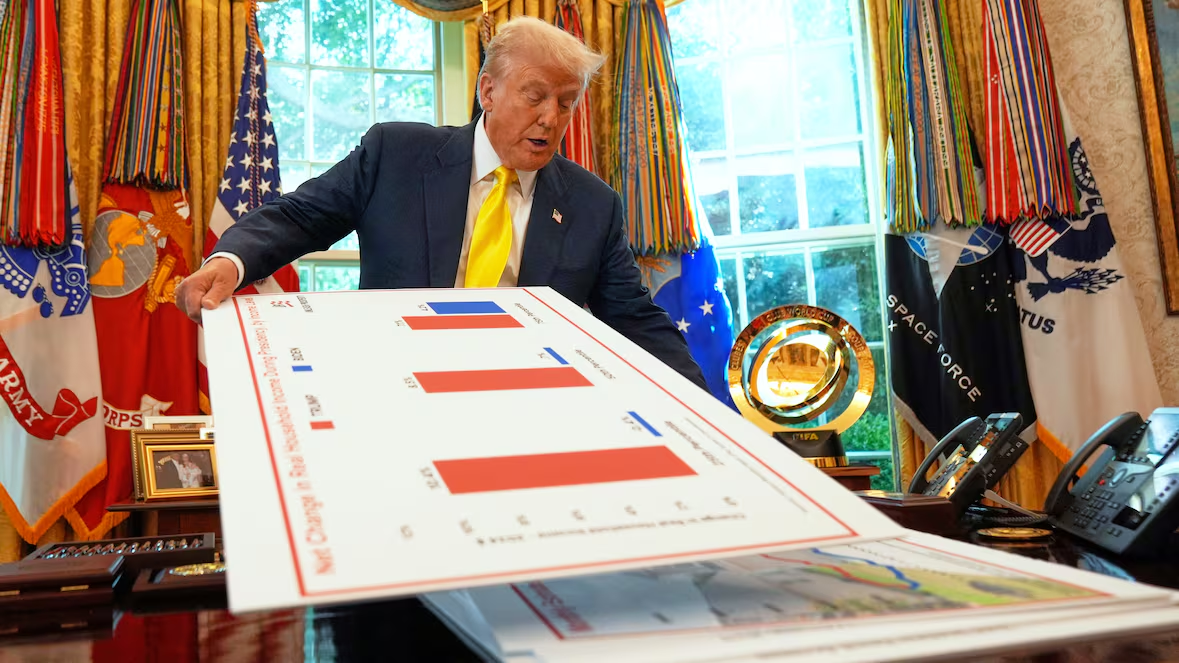
How Trump's Tariffs Redistribute Wealth Up the Economic Ladder
Trump tariffs redistribute wealth in ways most shoppers never notice. On paper, tariffs sound like a tool aimed at foreign competitors. In practice, economists say the money flows from ordinary households straight into the accounts of large, politically connected corporations. The gap between the promise and the outcome tells its own story.
Big Promises, Missing Jobs
“We will take in trillions and trillions of dollars and create jobs like we have never seen before,” U.S. President Donald Trump told Congress in his state of the union address in March 2025. It was one of many forecasts of a new golden age fuelled by tariffs.
This wasn’t a new pitch. Back in 2018, during his first term, Trump made a similar claim on social media: “Because of Tariffs we will be able to start paying down large amounts of the $21 Trillion in debt that has been accumulated, much by the Obama Administration, while at the same time reducing taxes for our people.”
However, the jobs never fully materialized. This month, U.S. government debt blew past the $40-trillion mark, rattling the bond market and keeping interest rates elevated. Meanwhile, the tariffs themselves have quietly reshaped who wins and who loses in the American economy.
As the saying goes, it’s an ill wind that blows nobody any good. While tariffs have caused real hardship for many families, they have also created a windfall for others. One of the clearest effects, according to economists, has been a massive transfer of wealth from the poor and middle class toward the wealthy and well-connected corporations.
Who Really Pays the Tariff Bill
This pattern fits neatly with the broader, largely unstated economic direction of the Trump administration and the Republican Party. Tax policy has pursued similar goals for years.
“This is consistent with other current trends. Red states in the U.S. are facing co-ordinated efforts to reduce income taxation and to increase sales taxes, which would have similar effects,” said Veljko Fotak, an associate professor of finance at the University of Buffalo’s School of Management.
In fact, the effect runs so deep that some economists argue tariffs aren’t really aimed at “foreign cheaters” at all. Instead, they suggest the real target is the principle of progressive taxation itself.
Spending Habits Tell the Story
Lower-income households simply spend more of what they earn, and that makes them more exposed. “Tariffs effectively tax consumption, and lower-income households consume a bigger proportion of their paycheque,” Fotak explained. “Taxing consumption sounds fair, until you realize that Warren Buffett and Elon Musk ‘consume’ a minuscule proportion of their income and an even lower proportion of their wealth.”
There’s a second, subtler mechanism at play too. Wealthy households spend differently, and that difference shields them from much of the impact. “Wealthy households tend to spend a bigger proportion of their paycheque on services and things like travel, which are less affected by tariffs than expenditures on manufactured goods. The things you buy at Walmart are impacted by tariffs. Your spa appointment or your kid’s violin lessons, much less so,” Fotak said.
As a result, a policy sold as protecting American workers ends up taxing their grocery runs and big-box purchases far more heavily than it touches the leisure spending of the rich.
Refunds, Exemptions, and Political Connections
The wealth-concentrating effect of tariffs has been made even stronger by an arbitrary and highly political exemption and rebate system. This month, the U.S. Treasury passed the $100-billion mark in refunds paid out to businesses for money lost to Trump’s “Liberation Day” tariffs, which the U.S. Supreme Court ruled unlawful. Another $30 billion still remains to be paid under that ruling.
Walmart came out as the biggest winner, recovering almost $3 billion. Target wasn’t far behind, receiving just under $1 billion — a refund that dramatically improved its second-quarter results.
Ordinary families, by contrast, have seen far less relief. Democratic Gov. JB Pritzker of Illinois sent Trump a symbolic invoice demanding roughly $9 billion in refunds, based on an estimated tariff cost of $1,700 per family in his state. Unlike the payouts to giants such as Apple and Amazon, those refunds are unlikely to ever arrive.
The Price of Political Access
Both refunds and exemptions tend to favour big, well-connected corporations, according to economist Kimberly Clausing, who holds the Eric M. Zolt Chair in Tax Law and Policy at the UCLA School of Law. “These tariffs were implemented in a really chaotic and mercurial way, and sometimes in an unlawful way. And then they got reversed and people needed to get the refunds,” Clausing said.
Consequently, navigating that chaos has become its own advantage. “And when you look at a regime that’s so variable and so uncertain, the companies that have the legal and lobbying expertise to navigate that and have the connections to get the exemptions are doing a lot better than the small guys,” she added.
This kind of favouritism isn’t new — it dates back to Trump’s first term. A paper co-authored by Fotak in the Journal of Financial and Quantitative Analysis measured the value of political connections in securing relief from Section 301 tariffs on Chinese imports, first imposed in 2018.
The researchers compared how more than 7,000 exemption applications fared against publicly available data on lobbying and political donations. Only one in seven applications was approved. Notably, companies that donated to Republicans had significantly higher odds of success.
“What we saw was that firms producing very similar items faced different outcomes, depending on their levels and targets of political expenditures,” Fotak told CBC News. “A foldable raft manufacturer from California was denied an exemption, but its close competitor from South Carolina received one.”
The Bottom Line
Ultimately, the tariff story isn’t really about foreign competitors at all. It’s about who has the lobbyists, the lawyers, and the donor history to navigate a chaotic system. For everyday families, that means higher prices with little chance of relief. For politically connected corporations, it means billions in refunds and quiet exemptions.
Therefore, when policymakers debate tariffs, the real question isn’t just about trade balances. It’s about which Americans end up footing the bill — and which ones get to send the invoice back.