Wildfires Uncover Buried Bombs From World Wars Across Europe
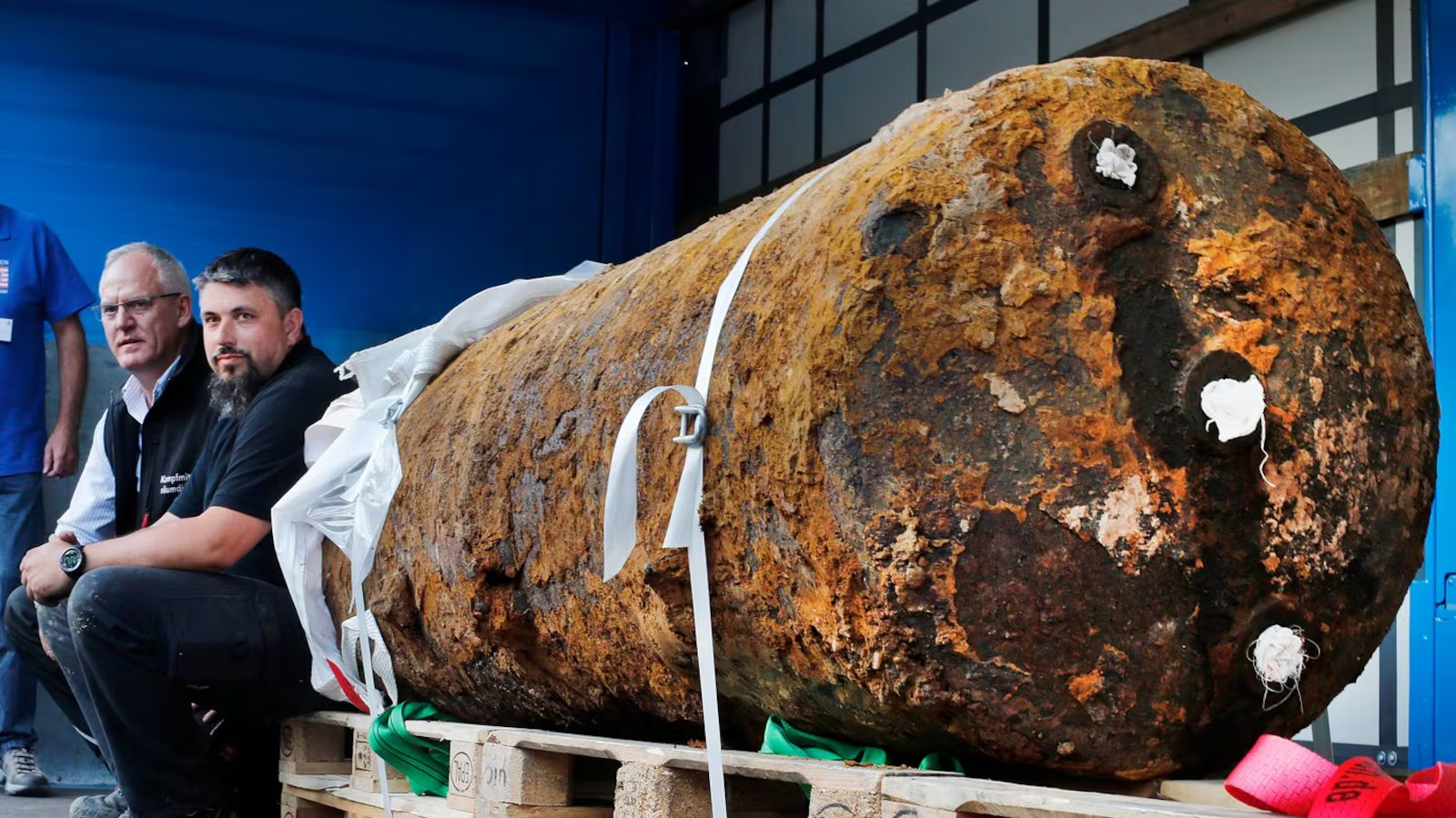
Europe’s summer wildfires are doing more than burning forests. They are digging up a dangerous piece of history. Across France, Belgium, Germany, and the Netherlands, flames have uncovered rusting bombs and mines left behind from the First and Second World Wars. As a result, bomb-disposal teams are now racing to keep pace with fires that are pulling old weapons out of hiding.
Some of these buried explosives have already gone off in the heat. Blasts have been reported in several countries, including near a former World War Two battle site in the Netherlands. Meanwhile, a bomb-disposal crew was sent to check a forest in the Limburg province after fire crept close to the area.
Climate Change Is Reawakening Old War Zones
For decades, Europe’s steady weather kept these buried weapons dormant. However, that balance is now shifting. According to Sarah Njeri, a peace and conflict scholar at London’s School of Oriental and African Studies, the continent’s “climatic luck” is running out.
“Climate change is now doing the work of unburying and reactivating what was previously stable,” Njeri explained. In other words, fire does two things at once. It can trigger old munitions directly, and it can also burn away the brush that once hid them from sight.
This year’s fire season was especially severe. Heavy rains in January encouraged fast vegetation growth. That greenery later dried out and became fuel once summer heat set in. A study released last month by the World Weather Attribution group linked the fires to a mix of drought, low humidity, and strong winds.
Old Battlefields Turn Into Fire Zones
As flames spread, they moved directly over land long known to hide unexploded weapons. This is a deadly legacy that has lingered for more than eighty years after the fighting ended. Consequently, firefighters are now dealing with a threat their training never fully anticipated.
Near Bordeaux in southwestern France, a large wildfire uncovered what is believed to be a cache of Second World War-era ammunition. Similarly, in Belgium’s eastern Liège province, Governor Hervé Jamar confirmed that “a few sporadic detonations” were recently heard as fires burned through munitions-laden land.
Although no fire crews were reported injured, local media captured photos of a firefighter handling a rusted bomb. This image alone shows how close the danger sits to daily emergency response work.
The High Fens forest, a dense peat-bog region in Liège, was heavily seeded with mines, bombs, and booby traps during the Second World War. In fact, in the first four years after Germany’s surrender in 1945, these leftover munitions killed six civilians. That detail comes from Bernard Collard, a local historian who runs the Truschbaum Museum near Belgium’s border with Germany.
“When you go into a forest like this, you are not sure where the explosives are,” Collard said. He still remembers watching his father detonate a bomb found in a nearby quarry, a memory that shows just how normal this danger once felt to local families.
Notably, the High Fens fire is smoldering across a border region soaked in wartime history. The Battle of the Bulge was fought in and around this same forest. Nearby, the lesser-known clashes along Elsenborn Ridge and in the Hurtgen Forest dragged on for 88 days and killed roughly 33,000 American and 28,000 German troops.
Belgium Still Handles Thousands of Bomb Calls Every Year
Collard is licensed to search old battlefields with a metal detector, and over the years he has found mortar shells, machine guns, helmets, cigarette cases, and even a human skeleton. “You never know what you might come across, and you shouldn’t take it lightly,” he said while standing in a field once soaked in blood from wartime fighting.
Today, blueberry bushes quietly cover old foxholes, trenches, and deep craters left by artillery fire. Collard often works alongside Belgium’s demining squad, treating the work as part of daily life rather than a rare emergency. “It’s part of our history. We live with it,” he said.
Unexploded ordnance becomes even riskier during wildfires because intense heat can trigger a blast on its own. Jonas Tepe, a spokesperson for Germany’s North Rhine-Westphalia region, confirmed this growing concern as fires spread closer to the German border.
Belgium’s Ministry of Defence reports receiving requests almost every week from the region for help disarming explosives. Even so, officials do not consider the area a major “hot spot” compared with other parts of the country. Requests are even more frequent farther west, near Ypres, a town infamous for brutal trench warfare in World War One. There, farmers call the yearly discovery of war debris during tilling season the “iron harvest.”
Nationwide, the numbers are striking. Belgium’s Explosive Ordnance Disposal and Destruction Service responds to more than 3,000 calls every year. Additionally, the service disposes of between 200 and 250 tons of leftover munitions from both world wars annually.
Shrinking Rivers Are Exposing Even More Weapons
Fire is not the only culprit here. Severe drought has also stripped away decades of natural cover by shrinking rivers and lakes across the region. As water levels drop, long-hidden weapons are resurfacing in places far from any battlefield.
In Slovakia, for example, a falling Danube River exposed two naval mines. Police later pulled them from the water and buried them in a trench for a controlled demolition. In Hungary, authorities closed Budapest’s Margaret Bridge after a Second World War-era bomb emerged near its base as the water receded. Likewise, German officials discovered a wartime bomb after the Rhine River dried up considerably.
Christina Greene, a researcher at the University of Arizona, co-authored a study with Njeri examining Europe’s wildfire and unexploded ordnance risks. She noted that “the legacy of war keeps creeping up” as climate change reshapes the landscape in unexpected ways.
“It’s reliving the legacies of war and conflict in a way that we haven’t had to deal with in a while in certain places,” Greene added. Ultimately, her point highlights a growing challenge: fire and drought are forcing Europe to confront a buried past that many hoped had been left behind for good.