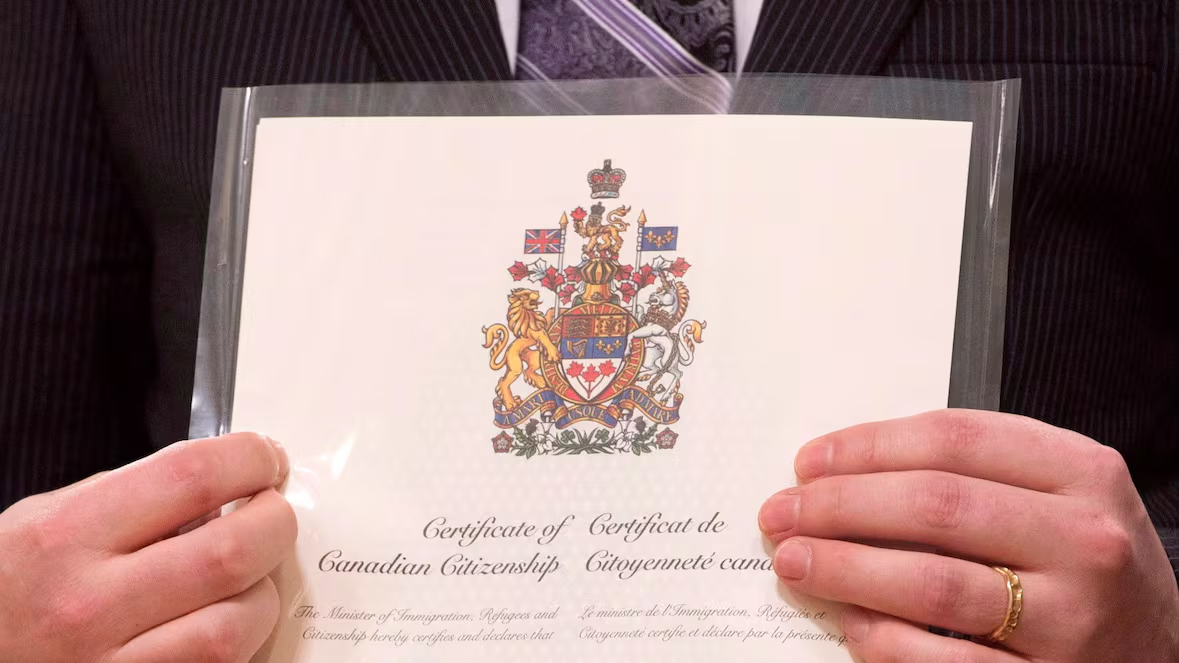
Canadian Citizenship Certificates: Demand Soars Among Americans
Demand for Canadian citizenship certificates is climbing fast, and Americans are driving much of the surge. New data obtained by CBC News shows that applications have jumped sharply in recent months. Thousands of people south of the border now want to claim Canadian roots. As a result, processing times have stretched far beyond what officials expected.
The rise comes after Parliament passed the “Lost Canadian” legislation, known as Bill C-3, late last year. This law lets people prove descent from a Canadian ancestor, even several generations back. Consequently, thousands who were previously excluded can now qualify. The change has reshaped how many families pursue Canadian citizenship certificates today.
A Surge Driven by Bill C-3
Bill C-3 followed a court ruling that found the old rules too restrictive. Previously, citizenship stopped at the first generation born outside Canada. Because of this, many descendants of Canadian emigrants lost their claim entirely. The new law reopened that door for a much wider group of applicants.
Between mid-December, when Bill C-3 took effect, and May 31, Immigration, Refugees and Citizenship Canada (IRCC) granted roughly 6,100 citizenship certificates under the new rules. That number is up from 4,075 certificates issued between mid-December and March 31. In other words, the pace of approvals nearly grew by half in just two months.
Meanwhile, another 17,390 people received certificates because they have a Canadian parent. Before Bill C-3, this parental route was the only path available to those born abroad. Together, these figures mean 23,490 people gained new Canadian status by the end of May. However, that number still represents only a fraction of expected applicants.
People born in the United States account for nearly half of these newly recognized citizens. Specifically, 3,110 Americans qualified through Bill C-3, while 8,125 more gained citizenship through a Canadian parent. These certificates allow successful applicants to apply for passports and to live and work in Canada. Still, Elections Canada notes that most cannot vote unless they have actually lived in the country.
The backlog tells an even bigger story. In April, around 56,000 applications sat waiting for a decision. By May, that number climbed to 70,400. Today, IRCC’s website lists 121,800 people still waiting, and the estimated wait time has doubled from 12 months to 25 months since August 10.
Estimates of the total number of eligible applicants vary widely. Some point to a century-long wave of Canadian emigration, particularly from Quebec, to American jobs in the 1800s and 1900s. The parliamentary budget officer has projected that 115,000 people could ultimately qualify. Last October, however, Immigration Minister Lena Metlege Diab told a House of Commons committee she expected no surge at all.
“We anticipate volumes in the tens of thousands over time,” she said at the time. “We do not expect any surge.” Taous Ait, a spokesperson for the minister, says IRCC prepared in advance and is now processing applications as quickly as possible. According to Ait, the department is “closely monitoring application volumes and trends” and will adjust operations as demand grows.
Archives Struggle to Keep Up
The surge in Canadian citizenship certificates applications has created ripple effects far beyond IRCC. Archivists across the country now face a sharp rise in requests for genealogical records. These documents prove an applicant’s unbroken line of descent from a Canadian ancestor. Therefore, archives have become an unexpected bottleneck in the entire process.
Alyssa Hyduk, president of the Association of Canadian Archivists, says her members feel overwhelmed. Some institutions have seen requests jump by 100 to 300 per cent. Many of these records date back hundreds of years. Furthermore, most requests appear to originate in the United States.
“I think across the board there is this overwhelming feeling of just, of overwhelm and burnout… it’s really having an impact,” Hyduk explained. She adds that the workload is also delaying service for other members of the public. Archivists must still handle their normal reference duties alongside this new demand.
The searches themselves are often painstaking. Records frequently predate Confederation or sit in small church archives. “We are at the point where we’re going through boxes and boxes of material to find a single document sometimes,” Hyduk said. “You are going through reels of microfilm to find ship manifests with one name.”
Digital tools offer little help here. “And these aren’t searchable documents,” she noted. “We can’t go to Ctrl+F and find a last name. We have to read the handwriting. We have to figure it out.” As a result, each request can take considerable time and manual effort.
Mab Coates-Davies, executive director of the association, points to the emotional weight of this work. “It is personal, it’s emotionally charged, it’s about family history,” she said. “There’s so many reasons that people, you know, might be looking to leave the States right now or planning for future moves.” She adds that IRCC does not experience this human side of the process directly.
Funding has not kept pace with demand, either. The flood of requests began just as the Carney government’s budget cuts ended a $1.5-million-a-year funding program for smaller archives. “This funding package was just cut and then our workload skyrocketed,” Coates-Davies said. The association is now calling for additional funding to help archives across Canada manage the load.
Adding to the strain, IRCC’s list of accepted documents keeps changing. When the association met with the department recently, officials declined to share a definitive list. They explained that requirements were likely to shift again soon. This uncertainty makes it harder for archivists to guide applicants efficiently.
What Lies Ahead
Another wave of demand may already be forming. In June, IRCC suddenly suspended around 100 previously issued certificates after flagging problems with submitted documents. Since then, 83 of those suspensions have been resolved, and the certificates were restored. The remaining 17 people received procedural fairness letters with 60 days to submit stronger proof of Canadian ancestry.
If these applicants cannot provide acceptable proof, their certificates could be revoked entirely. Archivists worry this could send even more people back to search for records. Given the current backlog, that outcome would add further pressure to an already strained system.
New Democrat immigration critic Jenny Kwan says she has received numerous letters from people affected by the suspensions. She has written to Minister Metlege Diab directly, demanding answers. “It really makes no sense whatsoever, what’s going on,” Kwan said. “And the minister is completely ignoring that reality right now.”
For now, demand for Canadian citizenship certificates shows no sign of slowing down. Thousands of Americans continue to explore their family history in hopes of gaining Canadian status. Meanwhile, IRCC and Canada’s archives must find ways to manage a workload neither fully anticipated. Until then, applicants face a long and uncertain wait.