Colombia Earthquake: 7.4-Magnitude Quake Kills 20, Traps Victims Under Rubble
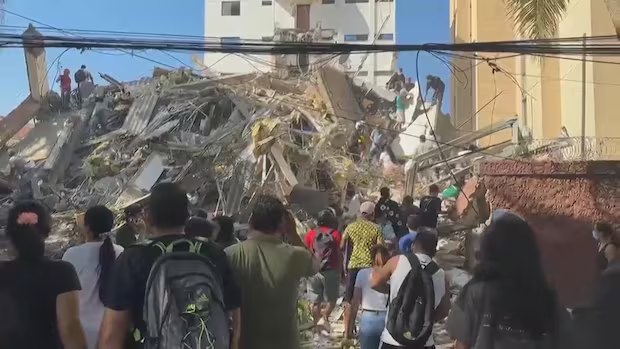
A powerful 7.4-magnitude earthquake shook western Colombia on Monday, leaving at least 20 people dead and dozens of buildings in ruins. The disaster struck several major cities at once, trapping residents beneath collapsed structures and injuring many more. As a result, thousands of people were forced to flee their homes, and tremors were even felt as far away as the capital, Bogota.
The scale of destruction has stunned a nation still adjusting to a new government. Rescue teams are now racing against time to reach survivors buried under debris. Meanwhile, officials across the affected regions are working to assess the full extent of the damage.
Death Toll Rises Across Pereira and Manizales
Local officials confirmed that at least 18 people had been killed in the city of Pereira. In addition, two more deaths were reported in the nearby city of Manizales. Consequently, the overall toll from Monday’s Colombia earthquake climbed to at least 20 victims.
According to the U.S. Geological Survey and its Colombian counterpart, the epicentre was located in San José Del Palmar. This small municipality sits in the Choco region and is home to roughly 4,800 people. Notably, it lies about 400 kilometres west of Bogota, and the quake struck at a depth of 107 kilometres.
Because the tremor was so strong, its effects reached far beyond the epicentre. Buildings shook violently in multiple cities, and the damage quickly became visible across the region. Therefore, emergency crews were deployed to several locations simultaneously.
Rescue Efforts Underway in Cali and Choco
In Cali, a city of roughly two million residents, Mayor Alejandro Eder said that people were trapped in at least 20 buildings that had collapsed. As a result, the city requested additional rescue teams from Bogota and Medellín to help with the search-and-rescue operation.
Choco Gov. Nubia Córdoba also addressed the situation on social media. She stated that “there are injuries and serious damage to buildings” in Quibdó, the regional capital, which has a population of about 130,000 people. However, she did not provide further details at the time.
Footage shared by local media outlets showed homes and small buildings collapsing in Pereira, Cali and Quibdo. Meanwhile, in Manizales, one of the towers of the city’s neo-Gothic cathedral fell and crashed onto the nave below. This image quickly became one of the most striking symbols of the disaster.
Hospitals were also affected by the chaos. In Cali, patients had to be evacuated outside a hospital after the earthquake struck, highlighting just how widespread the disruption became. Debris covered streets and vehicles in several neighbourhoods, further complicating rescue access.
Colombia’s Aviation Authority additionally reported that damage had occurred at multiple airports nationwide. This complication is likely to slow the delivery of emergency aid and personnel to the hardest-hit areas in the coming days.
Colombia’s History With Deadly Earthquakes
Small tremors, locally known as “temblores,” are fairly common across central and western Colombia. Even so, quakes above magnitude six remain rare in the region. For comparison, a 6.2-magnitude earthquake near Armenia in 1999 killed more than 1,100 people.
A decade ago, a similarly devastating event unfolded nearby. A 7.8-magnitude quake centred in Ecuador, but also felt across Colombia and Peru, killed more than 650 people. Given this history, Monday’s earthquake has reignited concerns about the region’s vulnerability to major seismic events.
Notably, this disaster follows two other massive quakes that struck neighbouring Venezuela. Back-to-back 7.2- and 7.5-magnitude earthquakes there destroyed hundreds of buildings and killed more than 5,000 people. Together, these events underscore just how seismically active this part of South America has become.
Government Response to the Colombia Earthquake
Abelardo de la Espriella, who was inaugurated as Colombia’s president only three days earlier, responded swiftly to the crisis. He said in a post on X that he will personally supervise recovery efforts and install an emergency centre in San José del Palmar. This move signals that disaster response will be an early test for his administration.
Meanwhile, coordination between cities has become essential to the response. Cali’s request for outside rescue teams shows how quickly local resources became overwhelmed. Similarly, Choco’s government is working to document damage while search operations continue in Quibdó.
As recovery efforts expand, officials are expected to release updated casualty figures. In the meantime, residents across the affected cities remain on edge, wary of aftershocks that often follow earthquakes of this magnitude. Authorities have urged people to stay away from damaged structures until inspections are complete.
Ultimately, the coming days will reveal the true scale of destruction from this earthquake. For now, rescue crews continue searching through rubble in Pereira, Cali, Manizales and Quibdó, hoping to find more survivors trapped beneath collapsed buildings.