DOJ Drops Reflecting Pool Vandalism Case Against Ex-Olympian
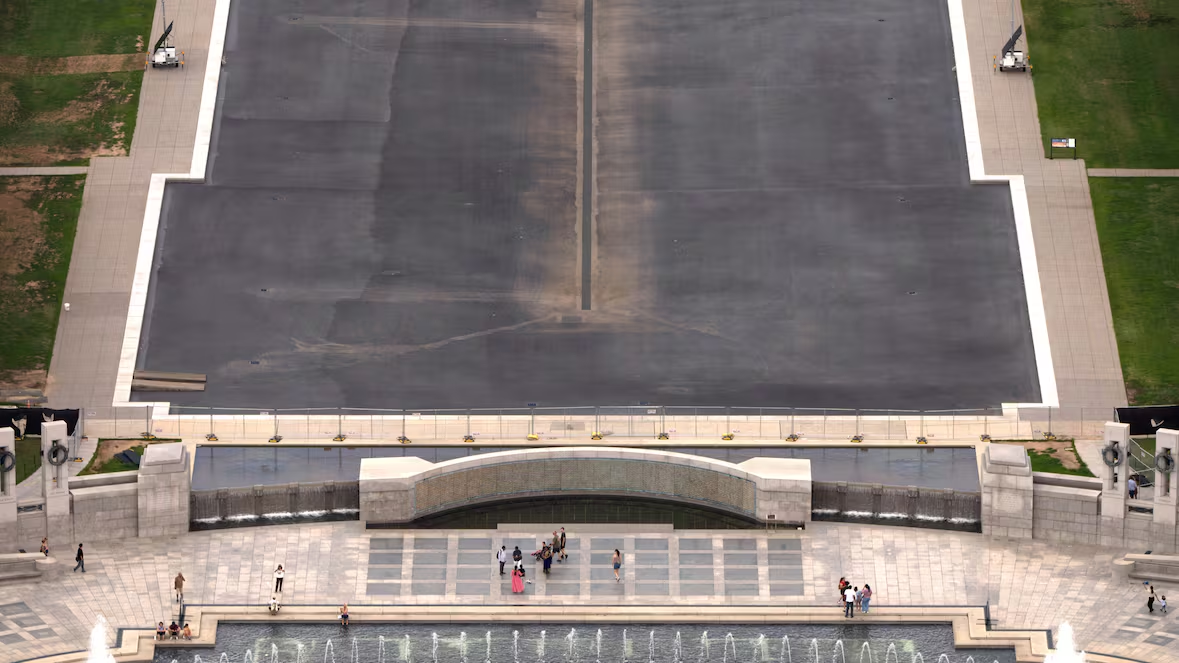
The reflecting pool vandalism case against former Olympian David Hearn has officially collapsed. The U.S. Justice Department moved Friday to dismiss the criminal charge, saying new evidence contradicts the original claim that vandals damaged the Lincoln Memorial Reflecting Pool. Prosecutors now admit the damage came from something else entirely.
Government lawyers filed a 20-page court document explaining the reversal. They said fresh information from the Interior Department shows the real cause was “a flawed installation by the contractor.” Officials also blamed the rushed construction timeline ahead of the America 250 celebrations around Independence Day 2026.
New Evidence Points to Botched Installation, Not Vandalism
A recent inspection of the pool revealed something prosecutors could not ignore. Damage appeared throughout the structure, including in the middle of the pool. Investigators noted that a vandal would unlikely target that section while attempting to peel the lining.
This detail weakened the entire theory behind the case. Consequently, prosecutors struggled to connect the damage directly to Hearn. U.S. Attorney Jeanine Pirro wrote in the filing that it became “difficult to attribute the widespread damage to the Reflecting Pool to vandalism, let alone to establish that fact beyond a reasonable doubt.”
Because of this, her office formally asked a judge to dismiss the case. The move effectively ends months of legal uncertainty for Hearn. It also raises fresh questions about how the original charges were filed in the first place.
Defence Says Trump Administration Owes Hearn an Apology
Hearn’s legal team did not hold back after the dismissal. They argued the Justice Department should never have pursued charges against him. According to their statement, the case reflected poor judgment from the very beginning.
The lawyers described the government’s approach as “ready, fire, aim.” They added that “its dismissal today does not erase the abuse of government power in arresting and charging a patriotic American who did nothing wrong.” They also said “the administration owes Mr. Hearn an apology.”
This dismissal is embarrassing for the Justice Department. Officials had originally framed the prosecution as accountability for damage at a major Washington landmark. President Donald Trump had launched a large renovation project there before the country’s 250th anniversary celebrations, and he claimed vandals caused the damage without offering evidence.
However, the case faced problems from the start. Hearn and his supporters consistently called it a politically motivated attempt to shift blame. Many observers felt the administration wanted a scapegoat rather than a thorough investigation.
Grand Jury Testimony Raised Red Flags Before Dismissal
Just days before the dismissal, Hearn’s lawyers requested access to grand jury transcripts. They cited “irregularities” in how the process unfolded. Their concerns centered on testimony from a National Park Service official.
That official reportedly admitted the pool already showed damage before Hearn’s alleged involvement. The witness also could not quantify how much damage, if any, Hearn caused. Furthermore, the official said the same repairs would have been necessary regardless of Hearn’s actions.
Hearn’s attorneys summarized the testimony bluntly. They wrote that “the witness’s testimony established that the pool had substantial preexisting damage requiring repair before any alleged conduct by Mr. Hearn.” They added specific figures to strengthen their argument.
According to the filing, “the pool was leaking more than one million gallons of water per week; its expansion joints had exceeded their service life; and the liner already contained a rip.” These details painted a picture of long-term structural failure, not sudden vandalism.
A Case That Never Should Have Reached Trial
Hearn pleaded not guilty earlier this month to one felony count of property destruction. His trial had been scheduled for September 28 in D.C. Superior Court. The charge carried a maximum sentence of 10 years and accused him of causing at least $1,000 US in damage.
That trial will now never happen. Prosecutors admitted in Friday’s filing that they only recently received documents undermining their own case. They wrote that “it was not until after these documents were produced” that they learned the damage resulted from a “botched installation” rather than vandalism, as originally represented by the Interior Department.
Before that point, prosecutors said they “could only rely” on the initial claims blaming vandals. In hindsight, that early information appears to have been incomplete or simply wrong. The case now serves as a cautionary example of prosecuting before all evidence is gathered.
What Happens Next
For now, the dismissal closes a chapter that drew national attention to a symbolic Washington landmark. Hearn avoids trial, and his legal team continues pushing for public accountability from the administration. Meanwhile, questions remain about who approved the original construction work at the reflecting pool.
The Interior Department has not detailed what corrective steps it plans to take. Additionally, no timeline has been given for repairing the pool properly. As the story develops, further scrutiny will likely fall on the contractor blamed for the flawed installation.