FIFA World Cup Plan Scrapped After Backlash
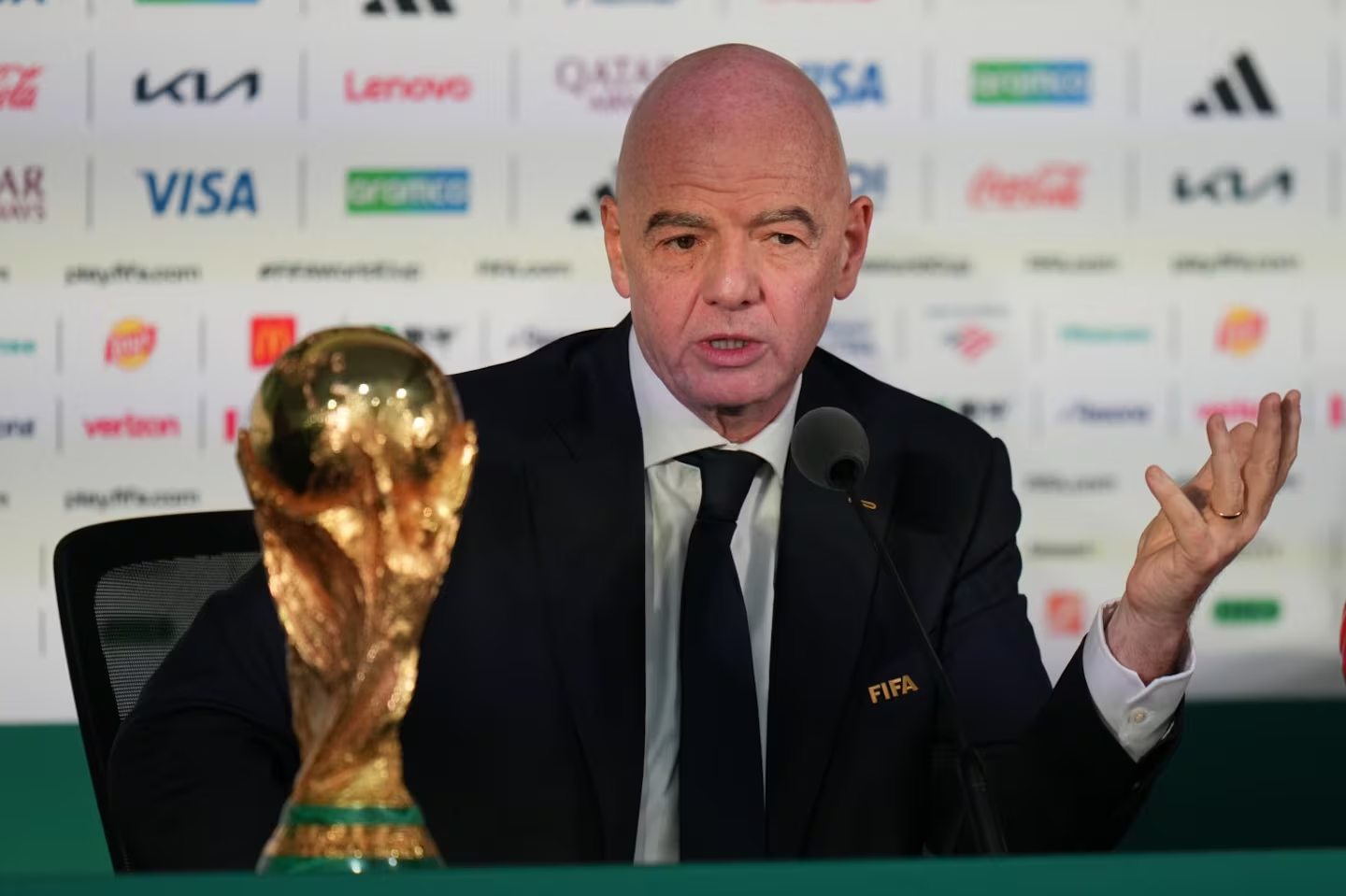
The controversial FIFA World Cup plan to sell private equity stakes in future tournaments has officially been scrapped. FIFA president Gianni Infantino confirmed the decision on Friday, following days of fierce backlash from football associations, players, and fans around the world. The announcement marks a dramatic reversal for world soccer’s governing body.
“Having listened carefully to all the views, it has become clear that the project has created divisions of a nature that, regardless of the level of support, are no longer in the interest of the objective set out in the first place,” Infantino said. “Our purpose has always been – and will always be – to unite and improve.”
He added a firm conclusion: “As a result, this proposal will not proceed.”
Consequently, the plan that once threatened to reshape the financial structure of the World Cup is now dead. However, the fallout it created within football’s global governance has left lasting questions about transparency and control.
What Was the FIFA World Cup Plan?
FIFA had announced plans earlier in the week to create a separate subsidiary, called FIFA Forward Enterprise (FFE). This entity would have controlled the commercial and operational rights to one of the world’s biggest sporting events. Importantly, the structure involved private equity investment, with outside investors set to own a significant share.
Roughly 20% of the FFE subsidiary was to be sold to private investors. The lead group behind the proposed deal was Thrive Eternal, headed by Joshua Kushner. Notably, Kushner is the brother of Jared Kushner, son-in-law of US President Donald Trump. This connection quickly became a lightning rod for criticism.
FIFA maintained that money generated through the deal would be reinvested back into football. Nevertheless, many stakeholders feared a different outcome altogether. Critics worried that private investors, driven by returns, would eventually push to influence decisions beyond their intended role.
Opposition to Infantino’s Proposal
Opposition to the plan grew rapidly and from multiple directions. UEFA, European football’s governing body, warned that the “soul and governance” of the game were under threat. As a result, UEFA’s 55 member associations unanimously voted to boycott future men’s and women’s World Cups if the plan proceeded.
Meanwhile, other confederations joined the resistance. CONCACAF and the Asian Football Confederation both rejected FIFA’s proposal, though neither threatened a boycott outright. Additionally, a spokesperson for the Oceania Football Confederation confirmed the matter would be reviewed by its executive committee in August.
Pressure also mounted from within FIFA’s own ranks. Carlos Cordeiro, Infantino’s senior advisor, resigned in protest just before the announcement. “I cannot stand by while FIFA considers selling a stake in the World Cup,” Cordeiro said. “Let me be clear: I had no involvement in this proposal, and I oppose it unequivocally… It is a bad deal for FIFA’s Member Associations, a bad deal for football, and a bad deal for the long-term future of the game.”
Kevin Lamour, FIFA’s chief operating officer, also spoke out publicly against the plan. “It is the project of one person,” Lamour told the Associated Press. He continued: “Not only must this project not go ahead… but the time has now come for football political leaders to ask themselves the right questions and make the right decisions.”
Lamour went further still, risking his own position. “And if that means I lose my job, then so be it,” he said. “I will understand and respect that decision. At least I’ll sleep well tonight.”
Criticism From All Angles
Beyond the financial structure itself, critics pointed to a broader lack of transparency in how the plan was developed. Consequently, many associations felt sidelined from a decision that would reshape the tournament’s future. This lack of consultation fueled much of the early anger.
Furthermore, the involvement of private investors tied to a politically connected figure added another layer of scrutiny. Many observers questioned whether outside financial interests should have any influence over football’s most prestigious event. Therefore, the backlash extended well beyond typical governance debates.
Initially, FIFA resisted calls to abandon the plan. On Thursday night, the organization issued a statement defending the FFE proposal. It said it “acknowledges and respects feedback and concern aired in public,” while blaming “erroneous” reporting in the media for fueling the controversy.
However, that defense did little to calm the storm. By Friday, the pressure had become impossible to ignore, and Infantino ultimately reversed course.
What Comes Next for FIFA?
Looking ahead, Infantino says his goal now is to reunite football’s global community. “Moving forward, my intent is to bring all interested parties back together in the coming days and weeks in the spirit of shared interest in our game, and with the objective to continue growing football everywhere, particularly in those countries that mostly need our support,” he said.
Meanwhile, attention now shifts toward FIFA’s next major events. The Under-20 Women’s World Cup is scheduled to begin on September 5 in Poland. Following that, the 2027 Women’s World Cup in Brazil will become the organization’s next big focus.
For now, though, this episode leaves FIFA facing rebuilt trust issues with its member associations. Ultimately, how Infantino handles the coming weeks may determine whether this controversy fades quickly or leaves a longer mark on his leadership.
Reporting contributed by Christina Macfarlane, Aleks Klosok, and Thomas Schlachter.