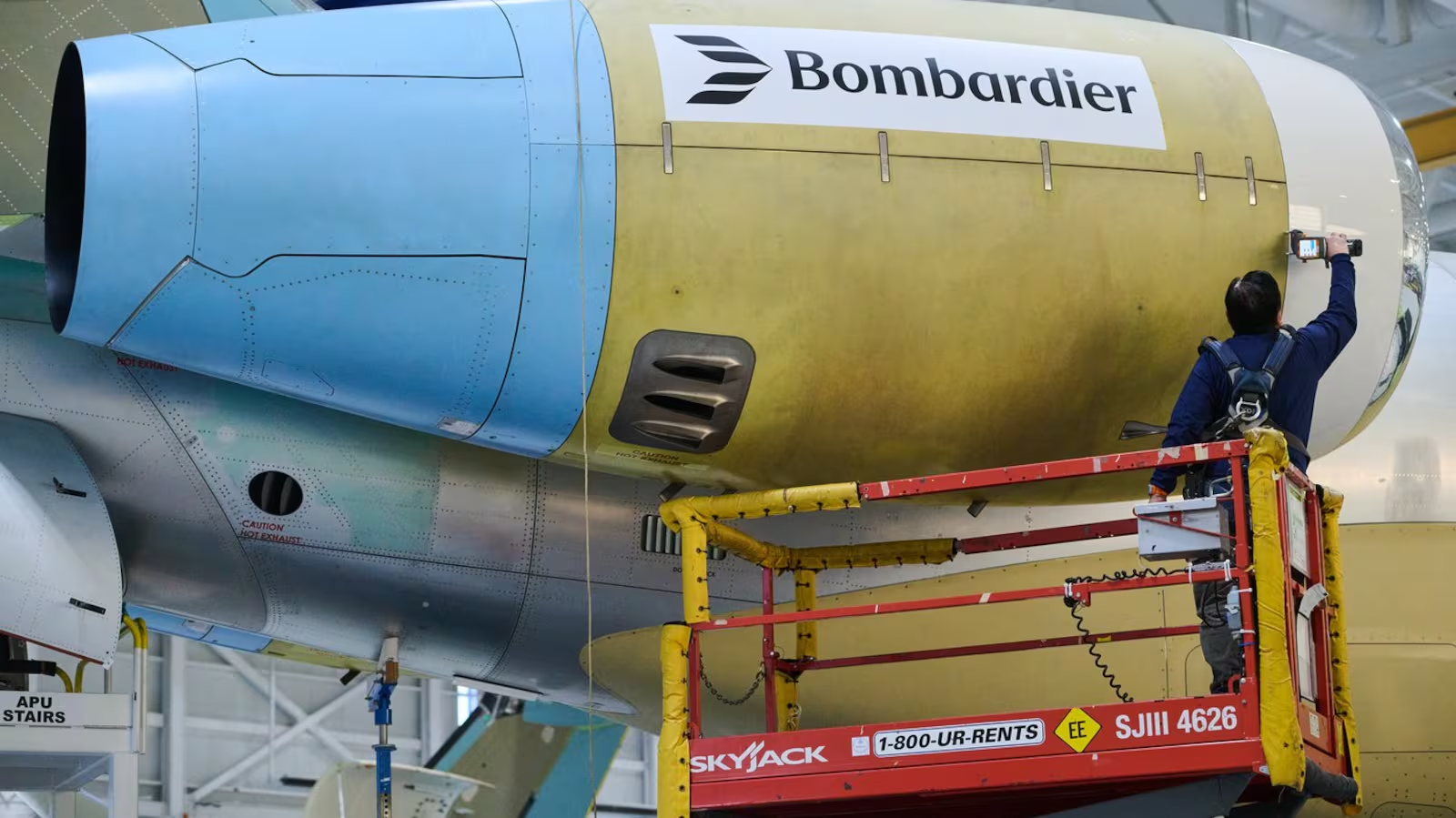
Bombardier Business Jets Demand Soars as CEO Eyes Mergers
Bombardier business jets are in higher demand than ever, and the company’s leadership wants to build on that momentum. CEO Éric Martel is now exploring acquisitions in aircraft services and defence. This comes as orders climb and the manufacturer’s once-heavy debt load keeps shrinking.
The Montreal-based company posted strong second-quarter results this week. Revenue rose six per cent year-over-year, reaching US$2.15 billion. As a result, investors and analysts are paying close attention to what comes next.
Strong Growth Fuels Bombardier’s Acquisition Plans
Nearly a third of Bombardier’s revenue came from its aftermarket maintenance and repair division. This segment jumped 14 per cent year-over-year, hitting a record $674 million. Because of this growth, Martel now sees room to expand even further.
“Organic growth is very solid,” Martel told analysts on a conference call Thursday. However, he believes the company can do more. “But there are also possibilities for us to do things that we don’t do today on our planes and have more penetration into the maintenance market.”
Acquisitions, he suggested, may be the fastest path forward. “The best way for us to get there could be by acquisition,” he said. “Clearly there’s possibilities out there that we are considering.”
Martel also pointed to defence as another growth area. “Same thing, I would say, in defence,” he added. “We’ll look at M&A opportunities.” Therefore, both segments could see fresh deals in the months ahead.
Meanwhile, demand for private aircraft continues to climb steadily. The company’s backlog of private plane orders jumped 25 per cent over six months, reaching $21.8 billion as of June 30. This surge reflects a broader trend across the private aviation industry.
Debt Falls as Bombardier Business Jets Stay in the Air
Bombardier also made real progress on its balance sheet this quarter. Net debt fell by more than US$350 million, according to Martel. Consequently, the company’s net leverage ratio dropped to 1.6 times — well below the threshold of three that’s generally considered healthy.
At the same time, business jets around the world are flying more often. The global fleet of roughly 24,000 aircraft is flying five per cent more than last year on average, Martel noted. This uptick signals renewed confidence in private travel.
Bombardier’s own planes are outperforming that broader trend. “The Challenger is seven per cent up, the Global is up eight per cent,” Martel said. He stressed that this creates opportunities for both servicing contracts and new aircraft sales.
“People are flying more and more private,” Martel said. “The demand is there.” Indeed, that appetite for exclusive air travel is showing up directly in Bombardier’s order books.
Last week, the company secured a major provisional deal. It received a tentative order for up to 60 jets from The Helicopter Co. in Saudi Arabia. This firm is backed by the country’s sovereign wealth fund.
The letter of intent covers 12 confirmed planes, plus an option for 48 more. Models included are the mid-size Challenger 3500, the long-range Global 5500 and the ultra-long-range Global 8000. Together, these aircraft span nearly every segment of Bombardier’s lineup.
Defence Contracts Add to Bombardier’s Long-Term Outlook
Beyond private jets, defence opportunities are also emerging for the company. However, Martel acknowledged these deals typically take longer to materialize. Still, he remains optimistic about what they signal for the future.
Earlier this month, NATO Secretary-General Mark Rutte discussed a related project. He said the alliance wants to work with Swedish manufacturer Saab on up to 10 radar jets, built largely in Canada.
Speaking at the NATO summit in Ankara, Turkey, Rutte explained the plan further. He noted the alliance’s aging fleet is to be replaced by the GlobalEye system. This system combines Saab’s technology with Bombardier’s Global 6500 business jet.
“Defence takes a longer time,” Martel said Thursday. “We’re not going to deliver those planes this year. But it gives us so much confidence for the future.” Clearly, defence remains a long-term bet rather than an immediate payoff.
Military clients also support Bombardier’s maintenance business in meaningful ways. Last month, the company signed a 10-year deal with the Swedish Armed Forces. This agreement covers servicing for two new Global 6500 aircraft.
Those jets will be used for “head-of-state transport,” among other missions. As a result, this contract adds steady, long-term revenue alongside the defence sales pipeline.
Quarterly Profit and Deliveries
On Thursday, Bombardier reported a profit of US$191 million for the quarter ended June 30. This figure was down one per cent from the same period last year. Even so, other financial metrics told a more positive story.
The company, which reports in U.S. dollars, posted adjusted earnings of US$2.50 per share. This was a sharp jump from US$1.11 per share a year earlier. Notably, it also far exceeded analysts’ expectations of US$1.41 per share, according to LSEG Data & Analytics.
Aircraft deliveries, meanwhile, came in slightly lower this quarter. Bombardier delivered 32 aircraft, down from 36 during the same period last year. Chief financial officer Bart Demosky said the dip was “attributable mainly to timing,” rather than any deeper demand issue.
Overall, the quarter reflects a company gaining confidence on several fronts. Revenue is climbing, debt is falling, and both private and defence markets are opening new doors. Given these trends, Martel’s mention of possible acquisitions suggests Bombardier may be preparing for its next major growth phase.