Immigration Control: Carney Says Canada Has Taken It Back
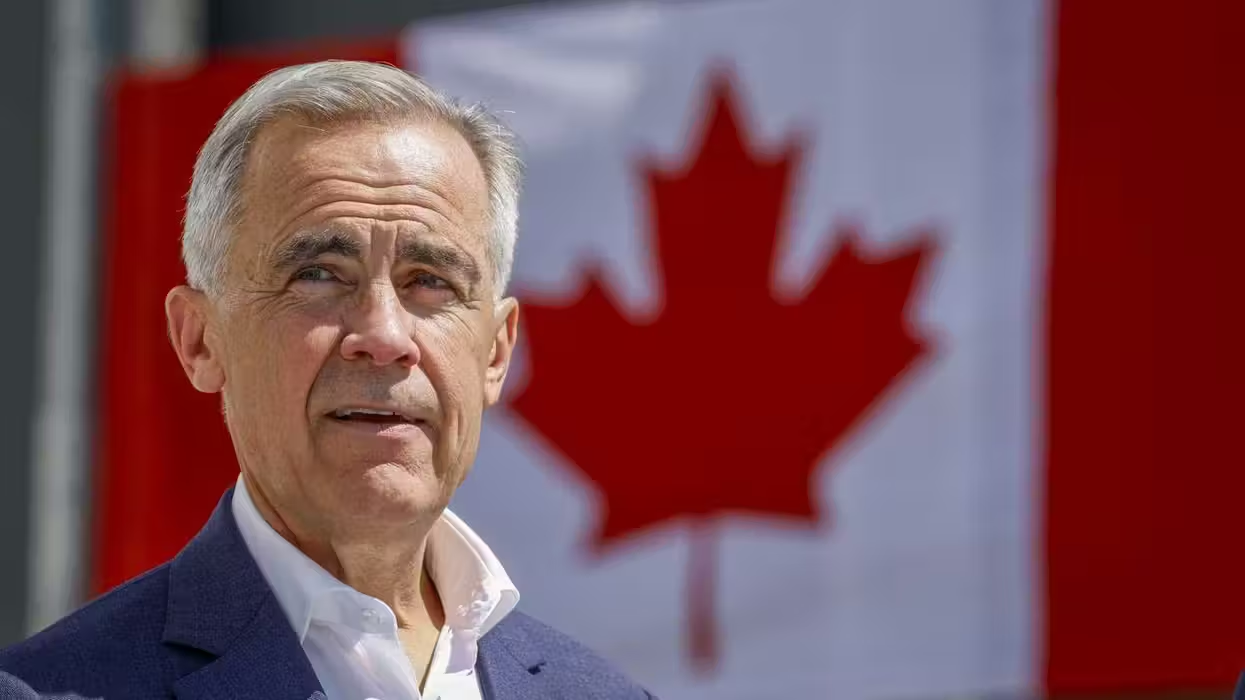
Prime Minister Mark Carney says Canada has reasserted immigration control after a period of rapid, unchecked growth. He made the comment at a press conference in Red Deer, Alberta, on Wednesday. Reporters asked him about Alberta’s upcoming referendum on provincial immigration powers. Carney’s response set the tone for a wider debate on how Canada manages newcomers.
The prime minister said immigration was “far too high” when his government took office. He added that Canada had “lost control” of student and temporary worker intake. As a result, his government moved to tighten the system over the past year. This shift now sits at the centre of his immigration control narrative.
Why Alberta Wants More Say Over Immigration
Alberta’s referendum will ask residents several pointed questions. One asks whether the province should assume greater authority over its own immigration system. Another asks if voters should prove citizenship before casting a ballot provincially. Together, these questions reflect growing frustration within the province.
A related question asks whether Alberta should limit public services to citizens, permanent residents, and those with “Alberta-approved” immigration status. This would affect access to healthcare and education. Two spinoff questions accompany this particular item on the ballot. The referendum, therefore, goes well beyond symbolic politics.
Premier Danielle Smith explained the province’s frustration with federal limits. “I think we’ve got 40,000 people who have sought permanent residency from us, and so that’s why I think need a bit of a better balance,” she said. Alberta currently has about 6,400 spots in its provincial nominee program this year. Smith then compared Alberta’s situation to Quebec’s arrangement.
“Quebec is able to choose about 45,000 of their permanent residents through a different program,” Smith said. “And so if you’re looking at the scale, we think that we need to be able to have more autonomy to do that.” Her comments highlight a broader push among provinces for flexibility. Consequently, immigration policy has become a central issue in federal-provincial relations.
The Numbers Behind Carney’s Claim
Carney pointed to a sharp decline across several immigration categories. Asylum seekers entering Canada, he said, have dropped by a third. Meanwhile, temporary foreign worker arrivals have fallen by half. Foreign student arrivals have dropped by two-thirds compared with previous levels.
Government data supports this trend. About 19,000 study permit holders arrived in Canada between January and May. Nearly 78,000 temporary workers arrived over the same period. By comparison, more than 115,000 international students and almost 209,000 temporary workers arrived throughout all of 2025.
Carney described the current situation as being “on top of the numbers.” He suggested the federal government and premiers now have room to discuss what comes next. However, he cautioned that pressure on housing has not disappeared. “The overall levels still are putting pressure on housing, so we still need a few more years of restraint. There’s a good argument for that but we need to discuss that,” he said.
What Comes Next For Immigration Policy
Carney noted that he and the premiers recently discussed prioritizing certain skills among economic immigrants. This conversation took place during a meeting in Prince Edward Island. Provinces, in turn, want a stronger say in choosing who qualifies. Skilled trades and in-demand professions are likely to shape future selection criteria.
Overall, Carney’s remarks suggest Ottawa views tighter immigration control as a necessary, if temporary, measure. Alberta, meanwhile, is testing whether voters want even more provincial authority. Both threads will likely intersect as the referendum date approaches. For now, immigration remains one of Canada’s most closely watched policy areas.
This report by The Canadian Press was first published July 29, 2026, with files from Bill Graveland in Red Deer.